
‘One-In-A-Million’ Super-Earth Resembling This Planet Has Been Spotted
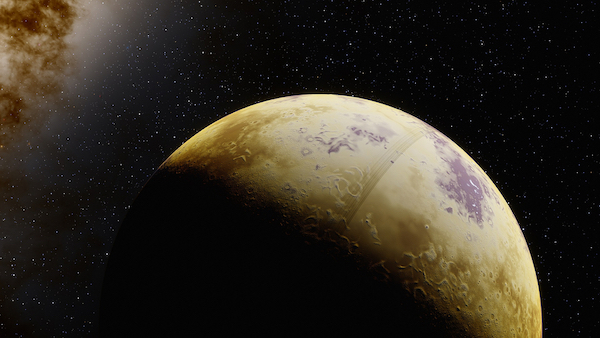
Image via lev radin / Shutterstock.com
If our Earth had taken a personality test, it probably would have been matched with this newly-discovered super-Earth from another star system.
Astronomers from the University of Canterbury (UC) in New Zealand believe they have made a “one in a million” discovery of an “extra-solar planet” with “sizes and orbits close to that of Earth.” Extra-solar planets, or exoplanets, are planets from beyond our solar system.
The super-Earth, found near the Milky Way’s bulge, has years spanning 617 days and revolves around a star smaller than the sun.
The team utilized a method called gravitational microlensing to find the exoplanet. “The combined gravity of the planet and its host star caused the light from a more distant background star to be magnified in a particular way,” astronomer Antonio Herrera Martin said in a press release. “We used telescopes distributed around the world to measure the light-bending effect.” The scientists’ findings were published in The Astronomical Journal on 7 May.
While it’s unclear what this “super-Earth” looks like, NASA previously detailed that super-Earths can be “up to 10 times” larger than this planet, and can have varying compositions such as gas, water or ice.
However, NASA also said it found an “Earth-size exoplanet” 300 light-years from Earth by looking at retired data from the Kepler space telescope last month. Coined as Kepler-1649c, the planet is believed to be habitable and “only 1.06 times larger” than this planet. Additionally, it receives starlight about 75-percent the amount that Earth gets from the sun, suggesting that the temperatures in both planets are similar.
Astronomers have scoured our galaxy looking for a planet like Earth that might support life. Is the recently discovered Kepler 1649c that Earth twin? Is there any hope that astronomers will find a truly habitable planet besides Earth? See my latest blog:https://t.co/YWXjcDrAbZ pic.twitter.com/Ordif9BR3T
— Hugh Ross (@RTB_HRoss) May 11, 2020
[via CNET, cover image via lev radin / Shutterstock.com]
Also check out these recent news


