
Astronomers Spot Possible First Birth Sighting Of Baby Planet In Blazing Swirls
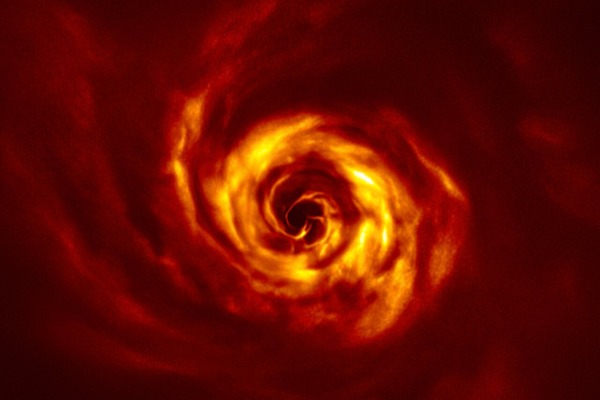
Image via European Southern Observatory / Boccaletti et al
The European Southern Observatory’s (ESO) Very Large Telescope (VLT) has discovered what is believed to be a baby planet being formed through images of flaming orange swirls.
The observation was reported in a study published this Wednesday in the journal Astronomy & Astrophysics. The baby star system, dubbed as AB Aurigae, was found around 520 lightyears away from Earth in the Auriga constellation, and might be the first evidence of a new planet being born.
The orange swirls are formed by an intense disc of dust and gas, and the yellow twist in the middle is a telltale sign of a baby planet growing in the universe. “The twist is expected from some theoretical models of planet formation,” explained Anne Dutrey, co-author of the report and a researcher at the Astrophysics Laboratory of Bordeaux in France.
1/4 Observations with ESO’s SPHERE instrument on the Very Large Telescope have revealed the telltale signs of a star system being born.
— ESO (@ESO) May 20, 2020
Credit: @ESO /Boccaletti et al.https://t.co/gyY4jpC1lR pic.twitter.com/ctJEB7POCA
2/4 The young system, AB Aurigae, lies only 520 light-years away from Earth in the Auriga constellation.
— ESO (@ESO) May 20, 2020
Credit: @ESO /Boccaletti et al. /M. Kornmesserhttps://t.co/zJg4DdYRB5
3/4 Around the young star lies a dense disc of dust and gas where astronomers have spotted a prominent spiral structure with a twist that marks the site where a planet may be forming.
— ESO (@ESO) May 20, 2020
Credit: @ESO /Boccaletti et al. pic.twitter.com/HvFVJvhcmi
4/4 This feature, found in 2019 and early 2020, could be the first direct evidence of early planet formation in a young stellar disc.
— ESO (@ESO) May 20, 2020
Credit: @ESO, @IAU_org and @skyandtelescope pic.twitter.com/mKkfEOyvtv
[via The Guardian, cover image via European Southern Observatory / Boccaletti et al]


