
Scientists Remarkably Create New Fish Hybrid, The ‘Sturddlefish,’ By Accident
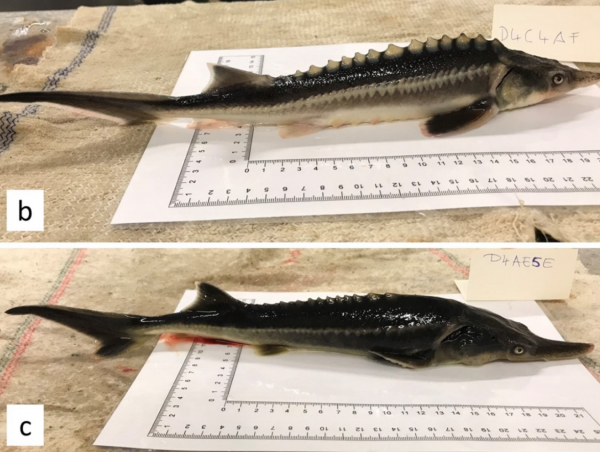
Image via Genes (CC BY 4.0)
Scientists in Hungary were not at all prepared for what was to come when they attempted to breed two critically endangered fish species, the Russian sturgeon and American paddlefish, as a conservation measure.
To their amazement later on, they were greeted by a rather fishy surprise—a hybrid now catchily known as the sturddlefish.
The team recorded their findings in the Genes scientific journal, explaining there that the accidental creation of the new species came about after pondering if the near-extinct Russian sturgeon (Acipenser gueldenstaedtii) and American paddlefish (Polyodon spathula), “fossil fish” that dated back to ancient times, were able to breed in captivity.
To get their answer, they adopted a method of asexual reproduction known as gynogenesis, which involved the sperm of paddlefish being used to fertilize sturgeon eggs. The experiment turned out swimmingly, though not in the way they had hoped.
When the eggs hatched, they revealed the new sturddlefish hybrid. Interestingly enough, the offspring differed in appearance according to the parent whose traits they inherited the most. Sturddlefish with twice as much DNA from the maternal side, the sturgeon, bore more resemblance to the Russian fish. Another group possessing an equal amount of paddlefish and sturgeon DNA was a perfect mix of the two species, according to CNET.
The breakthrough marked the first successful hybridization of the two fish species.
Attila Mozsár, a scientist from Hungary’s Research Institute for Fisheries and Aquaculture and one of the researchers involved in the study, emphasized to the New York Times that the team “never wanted to play around with hybridization,” and that the result was “absolutely unintentional.”
However, the sturddlefish family won’t be joining open waters in the foreseeable future, as human-made hybrid fish are usually sterile and aren’t able to produce offspring in the wild.
[via CNET, cover image via Genes (CC BY 4.0)]
Also check out these recent news


