
Cardi B’s Grotesque Vid Sees Chest Stud Dangling Off From Her Body’s ‘Rejection’
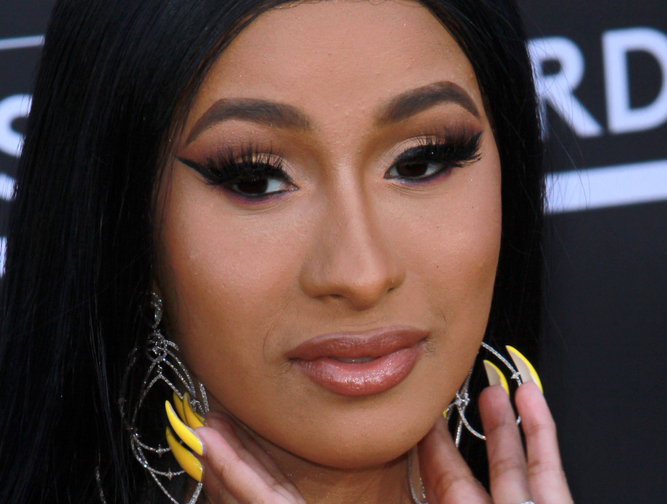
Image via Kathy Hutchins / Shutterstock.com
While most celebrities try to paint their Instagram feeds to look as beautiful as possible, Cardi B’s posts are a refreshing mix of ritzy and defiantly real. The rapper occasionally uses her platform to share realities behind “effortless” social media shots.
This time around, she has revealed how the healing process of piercings doesn’t always go smoothly no matter how equipped you are about aftercare.
In a video posted to her Instagram stories she demonstrated touching her chest jewelry, only for it to get pushed out of her body. You can watch it below—but be warned, it is quite graphic and can make you squirm.
“This is how my piercing has been for the past four days,” she groaned.
As reported by Health, this unsettling response is medically known as a “piercing rejection.” While piercings are bound to cause inflammation in the first stages, piercing rejection involves the wound migrating the piercing “toward the skin surface and can even cause it to perforate out of the skin,” Angelo Landriscina, MD, dermatology chief resident at George Washington University Hospital in Washington, DC, told the publication.
This is because the body has detected the foreign object and is fighting to “reject” it, Dr Landriscina added.
Medical professionals still don’t know too much about piercing rejection, though the sort of piercing might raise the likelihood of it occurring. Surface-level ones, which are piercings on flat areas of the body, are believed to be refused more frequently by the body than other types. Cardi B’s three chest piercings fall in this category.
Dr Landriscina described that symptoms of piercing rejection include “local swelling, redness, warmth, and excessive discharge,” and they normally appear in the following days since the procedure and worsen over time.
He advised those encountering piercing rejection to remove the jewelry “as soon as possible rather than letting it fall out on its own,” as keeping the exposed area in contact with the piercing “can result in unsightly scarring.”
Once the piercing is removed, it is encouraged to wash the affected area with regular soap and water once a day to keep it sanitized, and then introducing “moisture” like petroleum jelly to help the skin heal before protecting it with a bandage.
[via Health, cover image via Kathy Hutchins / Shutterstock.com]
Also check out these recent news


