
NASA Captures Two Galaxies Colliding Into A Massive Swirl In The Cosmos
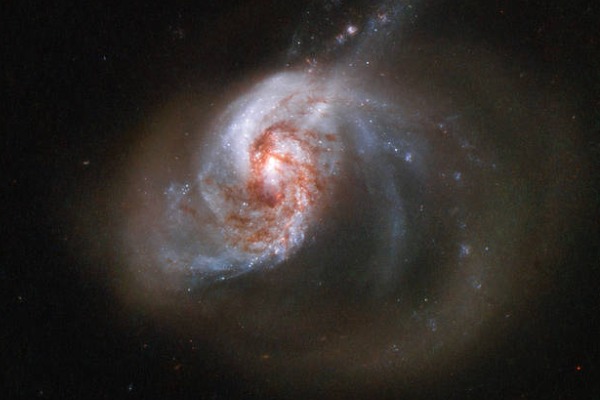
Image via ESA/Hubble & NASA, A. Adamo
NASA has released an image from its Hubble space telescope showing NGC 1614, also known as a “peculiar galaxy.”
The image captured two magnificent galaxies merging into a “starburst galaxy.” At the upper right, you can see a “tidal tail” trailing outwards. This tail comes from the stars and gas “stripped” from the galaxies during a collision, per Cosmos.
At the center of the collision, NASA pointed out a “burst” of radiant star formation. This occurs when gases from the smaller galaxy enter into the larger galaxy. This formation resides around 200 million light-years from Earth.
The space agency also noted that this galaxy is the “second most luminous galaxy” within 250 million light-years from Earth. Take a look at the majestic image below.
#HubbleFriday NGC 1614 is a peculiar galaxy. Its odd shape is the result of a galactic merger and comes complete with a tidal tail (a trail of stars and gas flowing outward).
— Hubble (@NASAHubble) August 14, 2020
It's also the second most luminous galaxy within 250 million light-years of us: https://t.co/lpM0054PZy pic.twitter.com/BXRkQp79ft
[via Mashable, cover image via ESA/Hubble & NASA, A. Adamo]
Also check out these recent news


