
Astronomers Spot A Rare Type Of Black Hole That Has Never Been Discovered Before
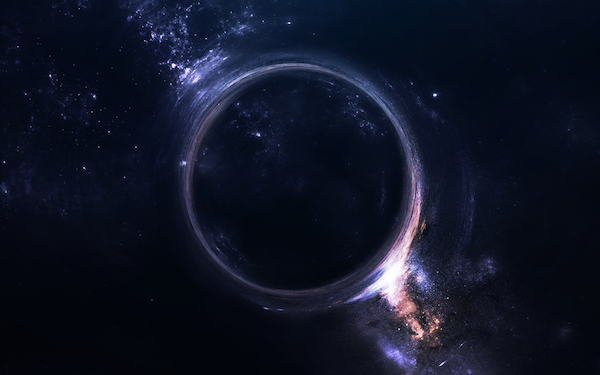
A composite graphic of a black hole, stitched together with images from NASA’s collection. Image via Shutterstock
Black holes have always been a point of fascinating part of the cosmos.
Astronomers often categorize them in two significant types from the sizes: stellar black holes and supermassive black holes.
The stellar black holes, also known as collapsars, come into existence from the gravitational collapse of a dying star. They often have masses ranging from five to several tens of solar masses.
The other type involves supermassive black holes with masses millions to billions that of our Sun.
However, they have now detected an intermediate-mass black hole (IMBH) that doesn’t fall into any of the two groups, making it a rare discovery in history.
On Wednesday, astronomers working with the Laser Interferometry Gravitational-Wave Observatory Scientific Collaboration (LSC) and the Virgo Collaboration detected gravitational waves from the formation of an IMBH, and it is 142 times the mass of our star.
The gravitational wave has been dubbed as the GW190521. Dr Karan Jani, research assistant professor from Vanderbilt University, told Engadget that the GW190521 was formed from “a collision of two black holes” that are “extremely massive; something that we know that stars cannot make.”
The black holes weighed around 85 and 65 times the mass of the Sun separately, and both were above the theoretical weight limit of collapsars.
“From our understanding of how stars age and evolve, we expect to find black holes with either less than 65 solar masses or more than 120 solar masses, but none in between,” said Frank Ohme, research group leader of Independent Max Planck Research Group at AEI Hannover.
“The 85 solar-mass black hole in the GW190521 origin system falls right in that gap where it shouldn’t be. This can mean two things: our understanding of stars’ evolution is incomplete, or something different has happened here,” Ohme further noted.
Though there are many uncertainties in the formation of GW190521, researchers find that two black holes likely collided together around six billion years ago in the region of space five gigaparsecs away. The implosion emitted “eight solar masses of energy,” which then formed a larger IMBH that was discovered by the team.
The ARC Centre of Excellence for Gravitational Wave Discovery (OzGrav) has released a video explaining GW190521. Check it out below.
[via Engadget, cover image via Shutterstock]
Also check out these recent news


