
NASA Reveals X-Ray Images Of The Majestic Universe In Technicolor
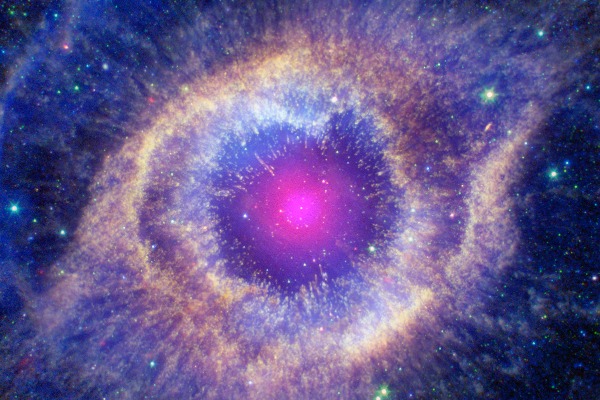
Image via NASA/CXC, NASA/JPL-Caltech/SSC, NASA/STScI(M. Meixner)/ESA/NRAO(T.A. Rector), NASA/JPL-Caltech/K. Su
NASA has released a video capturing the majestic universe through multiple telescopes from around the globe.
The space agency used various sources from infrared to gamma rays to depict the cosmos beyond the skies. Here are some of the striking images.
Messier 82
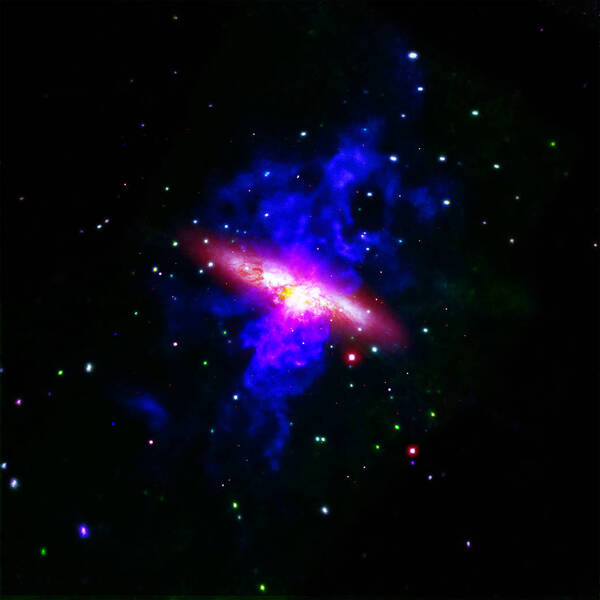
Image via NASA/CXC; Optical: NASA/STScI
The image shows the Messier 82 galaxy, which spans some 20,000 light-years away from Earth. The image used X-ray and optical light from NASA’s Chandra X-ray Observatory and Hubble Space Telescope respectively. It reveals radiant blue and pink patterns formed after multiple supernova explosions.
Large Magellanic Cloud
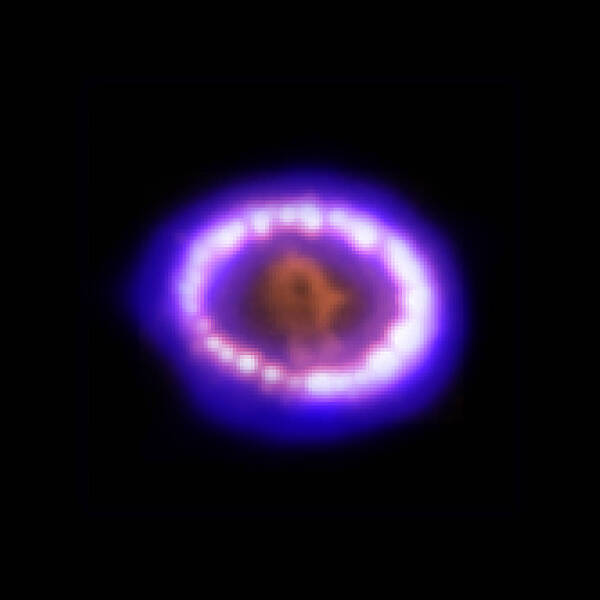
Image via ALMA (ESO/NAOJ/NRAO), P. Cigan and R. Indebetouw; NRAO/AUI/NSF, B. Saxton; NASA/CXC/SAO/PSU/K. Frank et al.; NASA/STScI
In this image, you can see the Large Magellanic Cloud, which is known to be one of the brightest supernova explosions in history. The striking pink shockwave in the middle lingers on the star’s remnants four light-years from the initial blast point.
Cartwheel Galaxy
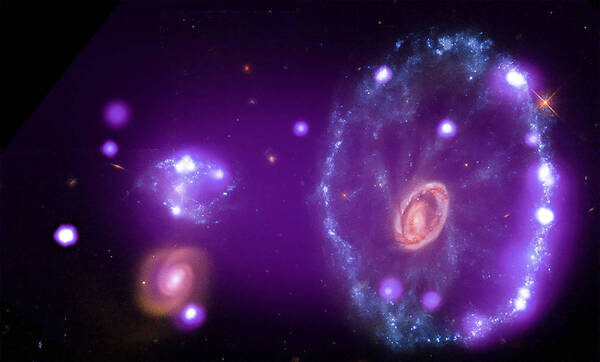
Image via NASA/CXC; Optical: NASA/STScI
The Cartwheel galaxy mimics a “bull’s eye” as a smaller galaxy had passed through the middle of the object. This collision resulted in shock waves that led to a massive amount of star formation in the area.
The X-rays from Chandra show a purple gas being dragged over more than 150,000 light-years from the collision. Seen in red, green, and blue colors, the Hubble’s optical data notes where the blowout might have sparked the stars' formation.
Helix Nebula
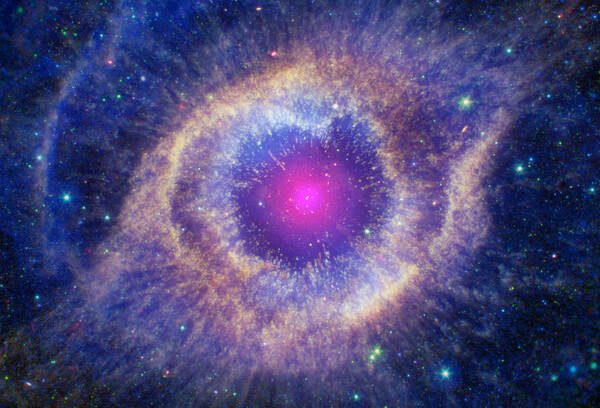
Image via NASA/CXC; Ultraviolet: NASA/JPL-Caltech/SSC; NASA/STScI(M. Meixner)/ESA/NRAO(T.A. Rector); NASA/JPL-Caltech/K. S
Astronomers learned that when a star like the sun runs out of energy, the core shrinks, forming a phase known as a “planetary nebula.” This is expected of Earth’s sun in about five billion years.
The Helix Nebula in the image spans across four light-years. The green and red spots signify the infrared data from NASA’s Spitzer Space Telescope, while the orange and blue parts reflect the optical light obtained from the Hubble. The ultraviolet from NASA’s Galaxy Evolution Explorer is marked in the cyan areas, and Chandra’s X-rays appear in white.
View more parts of the grand universe in the video below.
[via Futurism, cover image via NASA/CXC, NASA/JPL-Caltech/SSC, NASA/STScI(M. Meixner)/ESA/NRAO(T.A. Rector), NASA/JPL-Caltech/K. Su]
]
Also check out these recent news


