
Twinkies Don’t Stay Perfect Like 20-Year-Old Burgers—New Pics Show 1 ‘Mummified’
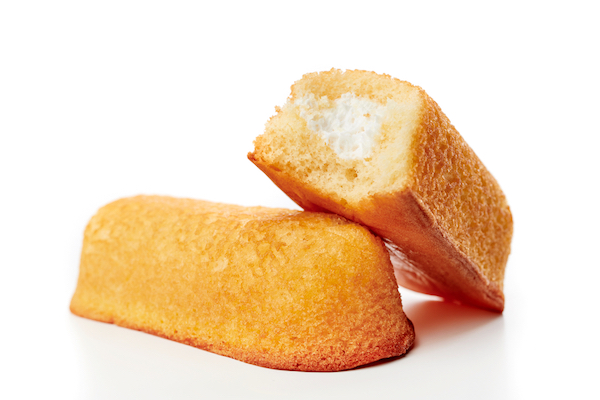
Image via Shutterstock
Twinkies, the perfect-looking American snack cakes, apparently don’t keep as well as you would imagine for a packaged food item.
This bittersweet revelation was made after Colin Purrington, a nature photographer and evolutionary biology lecturer at Swarthmore College, remembered he had a box of Twinkies stashed away in his basement from eight years ago and decided to have a go at them after hunger pangs struck.
While the cakes were marked with a shelf life of 45 days, Purrington decided to risk it, as most of them looked fine to him. Also, “When there’s no desserts in the house, you get desperate,” he shared with NPR.
Alas, the one Twinkie he tried tasted “like an old sock.” He also uncovered two others that had seen better days; the first was tainted with a large brown spot, whereas the other had a brownish-gray color and was all shriveled up. Clearly, these did not pass the McDonald’s preservation test.
Far from being a stale experiment, the encounter piqued the curiosity of Matt Kasson, interim director of the International Culture Collection of (Vesicular) Arbuscular Mycorrhizal Fungi at West Virginia University; and Brian Lovett, post-doctoral researcher from the Kasson Laboratory at the university’s Division of Plant and Soil Sciences. The two requested that Purrington send the cakes over to them for examination, and true enough, it was all not yellow.
The scientists detected that the brown spot in one of the samples was caused by the mold called Cladosporium, which Kasson described to Yahoo Life as a “very common mold” and food contaminant. Surprisingly, this cake still had its cream filling intact.
However, they haven’t been able to grow fungi out of the “mummified” Twinkie.
Packaged food items, the scientists detailed, aren’t likely to get fungi due to “the processes they have in place [to] keep out microbes.”
We have a new terrifying mycology project called Operation #MoldyTwinkie. @lovettbr & I will ID an unknown fungus or fungi growing inside individually wrapped 8-year-old expired @Hostess_Snacks Twinkies. These moldy cakes were discovered in @colinpurrington's basement. @MSAFungi pic.twitter.com/dsQGKvjFsv
— Matt Kasson (@kasson_wvu) October 8, 2020
The other fungus infected cake still had a typical cream filled center! #MoldyTwinkie pic.twitter.com/GZDu2NZ261
— Matt Kasson (@kasson_wvu) October 8, 2020
[via Yahoo Life, cover image via Shutterstock]
Also check out these recent news


