
Scientists Create Microscopic ‘Star Trek’ USS Voyager That Can Move By Itself

Image via Star Trek
A team of physicists has fulfilled something straight out of the dreams of kids with Sci-Fi ambitions. They’ve replicated the USS Voyager from Star Trek for science.
The researchers from Leiden University in the Netherlands have successfully 3D-printed a microscopic model of the starship that can move by itself. The structure was created to better understand the movements and interactions of microswimmers, which are small particles that can propel themselves by reacting to surrounding liquids.
According to Boing Boing, the tiny vehicle—measuring at just 15 micrometers (0.0006 inches) long—is even smaller than a human hair, which has an average diameter of 75 micrometers.
The microswimmers, coated in platinum, would interact with their hydrogen peroxide environment and propel themselves through the liquid.
The physicists discovered it was possible to print out any shape of microswimmers with a 3D printer, and had fun creating shapes like boats and helices, aside from the Voyager replica. The microswimmers performed differently based on their structures, and the team would use these observations to identify the sorts of effects each shape would create.
As for why the team chose to recreate the Star Trek vessel, one of the study’s authors, Samia Ouhajji, told CNN that co-author Jonas Hoecht is a “major Star Trek fan” and had been promised that “we could print any shape he liked.”
Above that, it was to prove that “the type of shapes we can print is almost limitless,” Ouhajji shared.
The researchers said that producing different shapes of synthetic microswimmers will help them better understand biological microswimmers so they can develop superior drug delivery vehicles. “For example, microrobots that swim autonomously and deliver drugs at the desired location in the human body,” Ouhajji reasoned.
The microscopic structures can also provide more clarity for the way biological swimmers like sperm and bacteria travel through the body.
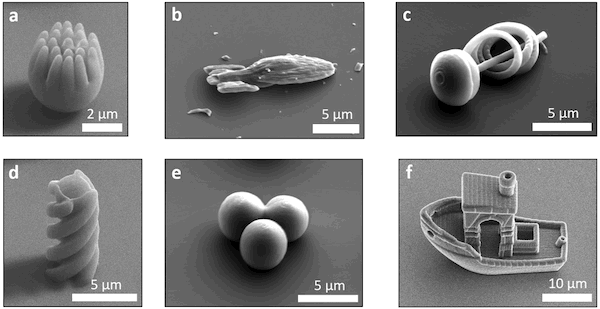
Image via R. P. Doherty, T. Varkevisser, M. Teunisse, J. Hoecht, S. Ketzetzi, S. Ouhajji and D. J. Kraft
A team of physicists at a university in the Netherlands have 3D-printed a microscopic version of the USS Voyager, an Intrepid-class starship from Star Trek. The miniature Voyager measures 15 micrometers (0.015 millimeters) long. Looks like they need to dial the printer in more.😉 pic.twitter.com/r8lvOTmStP
— 3D Medic Vince (@MedicVince) November 9, 2020
Image via R. P. Doherty, T. Varkevisser, M. Teunisse, J. Hoecht, S. Ketzetzi, S. Ouhajji and D. J. Kraft
[via CNN and Boing Boing, images via various sources]
Also check out these recent news


