
NASA Reveals Alluring Images From ‘Grand Canyon Of Mars’ 10X Larger Than Earth’s
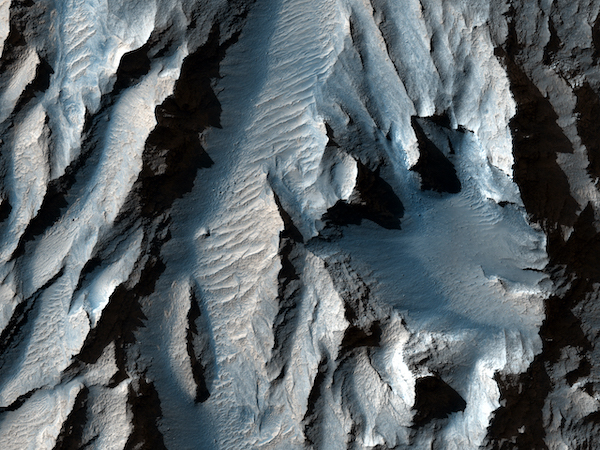
Image credit: NASA/JPL/UArizona. Via HiRISE Operations Center
Mars may be deemed as a close match to Earth, but when it comes to the battle of Grand Canyons, there’s really no comparison.
Piquing your wanderlust, NASA has unveiled new photos of Valles Marineris on Mars, the largest canyon in the solar system. The compelling images were photographed by the High Resolution Imaging Science Experiment (HiRISE) camera installed in the Mars Reconnaissance Orbiter.
The Martian canyon stretches some 2,500 miles, which is about the distance between New York and San Francisco, according to Travel + Leisure. It’s also nearly 10 times the length of Earth’s Grand Canyon and thrice as deep.
It remains unclear how the vast Valles Marineris—with a width of 125 miles and a depth comparable with Earth’s oceans—came to be, since the Red Planet is too hot and dry for a river to form a deep canyon system.
Scientists, however, have surmised that eruptions of volcanoes in the Tharsis region had cracked the planet’s crust billions of years ago, resulting in a canyon system almost a quarter the circumference of Mars.
In comparison, the Grand Canyon had come about from over billions of years of water coursing through its existing channels.
HiPOD: The Obliquity of Mars (Periodic Bedding in Tithonium Chasma)
— HiRISE: Beautiful Mars (NASA) (@HiRISE) December 26, 2020
This HiRISE image of an east-facing slope in Tithonium Chasma was taken to follow up an earlier Context Camera image that seemed to show sediment layers of near-uniform thickness.
More: https://t.co/7De3nMZvsI pic.twitter.com/oRvCNfWpk9
HiPOD: Light-Toned Deposits along Coprates Chasma Slopes
— HiRISE: Beautiful Mars (NASA) (@HiRISE) December 25, 2020
Valles Marineris contains kilometers-thick light-toned layered sedimentary
deposits along many of its floors. In this image, we find similar deposits along wallrock slopes in Coprates Chasma.https://t.co/hggCXZgTex pic.twitter.com/TUnhFN8nrj
Image credit: HiRISE (High Resolution Imaging Science Experiment)/Mars Reconnaissance Orbiter
— Jasmine 🌌🔭 (@astro_jaz) January 6, 2021
[via SlashGear, images via Delaware Humane Association]
Also check out these recent news


