
Behind The Design: How Pumpkins Have Inspired Yayoi Kusama’s Famous Artworks
Behind The Design is a segment brought to you by DesignTAXI where we wind back to the pioneering products and icons that steered the design world forward and transformed consumer perceptions forever.
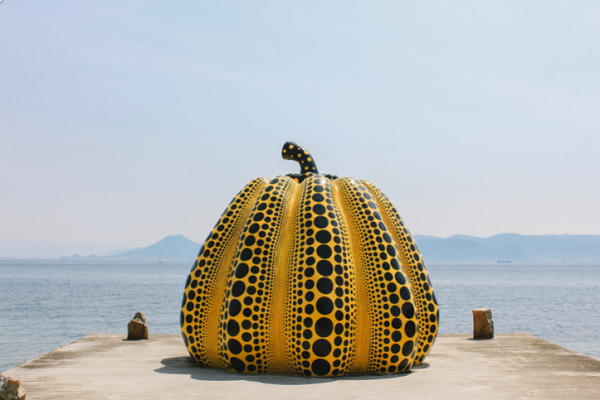
Image via Shutterstock
What: Pumpkins
Who designed it: Yayoi Kusama
When: As early as 1946
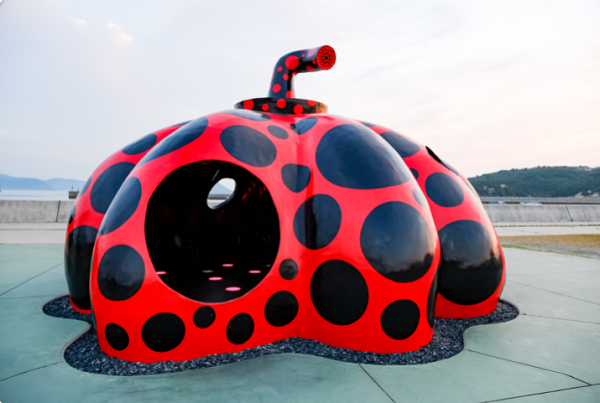
Image via Carlos Huang / Shutterstock.com
Yayoi Kusama has carved a name for herself, and throughout her career, the artist has developed a signature approach to her craft. Kusama is known for her polka dots, bold color palettes, and her famous pumpkin art.
Her love for pumpkins goes back to her early childhood when she grew up in Matsumoto, Japan. According to TheArtGorgeous, she experienced vivid hallucinations which involved dots, flowers and pumpkins. Unlike dots and flowers, which frightened her, she found comfort in pumpkins. Kusama’s family also owned a large supply of pumpkins while growing up during World War II.
The artist’s love for gourds continued into her teenage years. She even made her penchant for pumpkins public with Kabocha, a Nihonga-style painting she showcased in a traveling exhibition, according to curator and critic Catherine Taft.
The pumpkin motif disappeared from her portfolio for a while and emerged back again in the 1970s. During this time, Kusama’s pumpkins received the polka-dot treatment, appearing in prints and drawings. “I love pumpkins,” the artist said in a 2015 interview, “because of their humorous form, warm feeling, and a human-like quality.”
In 1991, Kusama launched an environmental installation called Mirror Room (Pumpkin) in Tokyo, and also exhibited at the 1993 Venice Biennale. Lucky visitors at the biennale left with their miniature takeaway pumpkins.
In 1994, Kusama created a free-standing pumpkin sculpture perched at the end of a pier in the Benesse Art Site. The piece laid the groundwork for Kusama's later open-air sculptures, which include Kirishima Open Air Museum in Kagoshima Prefecture, Japan; Matsudai Station in Tōkamachi, Niigata, Japan, and the Lille Europe Train Station in Lille to name a few.
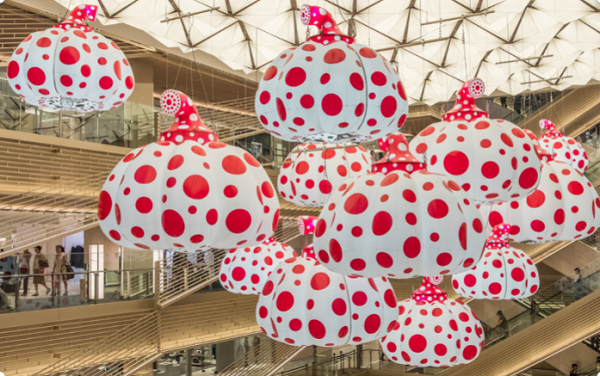
Image via MAHATHIR MOHD YASIN / Shutterstock.com

Image via ephst / Shutterstock.com
[via Phaidon, cover image via ephst / Shutterstock.com]
Image via Shutterstock
What: Pumpkins
Who designed it: Yayoi Kusama
When: As early as 1946
Image via Carlos Huang / Shutterstock.com
Yayoi Kusama has carved a name for herself, and throughout her career, the artist has developed a signature approach to her craft. Kusama is known for her polka dots, bold color palettes, and her famous pumpkin art.
Her love for pumpkins goes back to her early childhood when she grew up in Matsumoto, Japan. According to TheArtGorgeous, she experienced vivid hallucinations which involved dots, flowers and pumpkins. Unlike dots and flowers, which frightened her, she found comfort in pumpkins. Kusama’s family also owned a large supply of pumpkins while growing up during World War II.
The artist’s love for gourds continued into her teenage years. She even made her penchant for pumpkins public with Kabocha, a Nihonga-style painting she showcased in a traveling exhibition, according to curator and critic Catherine Taft.
The pumpkin motif disappeared from her portfolio for a while and emerged back again in the 1970s. During this time, Kusama’s pumpkins received the polka-dot treatment, appearing in prints and drawings. “I love pumpkins,” the artist said in a 2015 interview, “because of their humorous form, warm feeling, and a human-like quality.”
In 1991, Kusama launched an environmental installation called Mirror Room (Pumpkin) in Tokyo, and also exhibited at the 1993 Venice Biennale. Lucky visitors at the biennale left with their miniature takeaway pumpkins.
In 1994, Kusama created a free-standing pumpkin sculpture perched at the end of a pier in the Benesse Art Site. The piece laid the groundwork for Kusama's later open-air sculptures, which include Kirishima Open Air Museum in Kagoshima Prefecture, Japan; Matsudai Station in Tōkamachi, Niigata, Japan, and the Lille Europe Train Station in Lille to name a few.
Image via MAHATHIR MOHD YASIN / Shutterstock.com
Image via ephst / Shutterstock.com
[via Phaidon, cover image via ephst / Shutterstock.com]
Also check out these recent news


