
Reuters Departs From Sharing Free Articles With Massive Rebrand
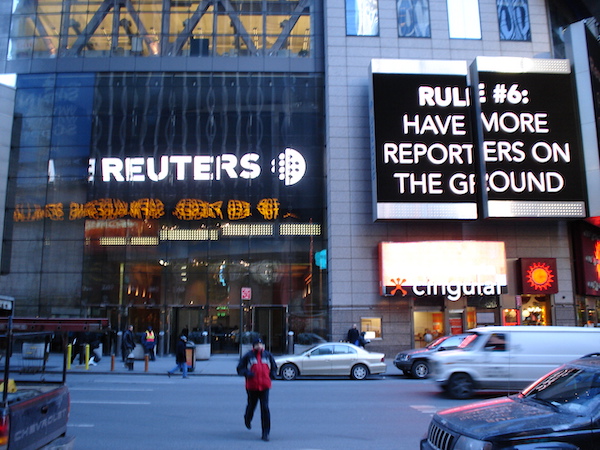
Image via Eternalsleeper / Wikipedia (CC BY-SA 3.0)
In a decision that would undoubtedly take long-time readers aback, Reuters News has announced that its online articles will be moved behind a paywall, marking a shift in demographic focus to “professional” readers. The news outlet believes this is the way forward for modern reportage, as “impartial and accurate news coverage” becomes more valued around the world.
To accomplish this, Reuters has rolled out a new subscription website where paying readers will be able to access “all the trusted news coverage, comprehensive analysis and global perspective you’ve come to depend on.” News will be augmented with “even more of award-winning photography, video and graphics,” it notes.
All that comes at a premium price. To read Reuters articles, audiences would have to fork out a brow-raising US$34.99 per month. This puts its paid content among the ranks of those from Bloomberg and The Wall Street Journal, the New York Times reports.
Visitors will be able to preview five free articles, and beyond that, they will be asked to register an account.
As part of the expansion, Reuters is opening up new verticals of coverage, including “legal, sustainable business, healthcare, and autos,” to help professionals make more refined decisions. Per the New York Times, there will also be industry-specific newsletters.
Josh London, Reuters’ Chief Marketing Officer, describes the rebrand as “the largest digital transformation at Reuters in a decade.” It is supported by a brand new website that allows the reader to customize their display according to favorite topics, watch live streams of Reuters events, view content from partners, and follow stories from specific journalists.
Appearance-wise, the website still sports a minimalist design to draw attention to its content, while giving readers more flexibility surrounding the news they wish to see.
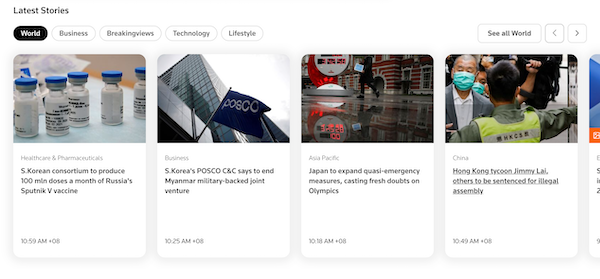
Screenshot via Reuters
The extreme revamp might disappoint some of Reuters’ 41 million monthly unique visitors, but the company seems convinced that putting a price on quality, in-depth, and impartial news is the way forward.
Reuters is putting its website behind a paywall after a redesign
— David S. Joachim (@davidjoachim) April 15, 2021
It'll cost $34.99 a month to subscribe after a free preview periodhttps://t.co/Ky9b9Rzpo7 @katie_robertson pic.twitter.com/dfCaMKMZyM
[via Input and Reuters, images via various sources]
Also check out these recent news


