
Jewel Made Of Gunpowder Is Stronger Than Diamond, Earth’s Hardest-Known Material
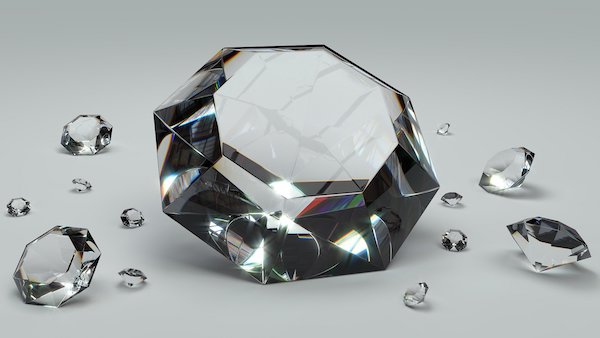
Image via Colin Behrens / Pixabay (CC0)
There’s a good reason why diamonds are so expensive. Aside from the years of marketing with questionable ethics, diamond is the hardest material attainable in nature. Now, scientists have created an alternative in the lab that might be even sturdier.
Lonsdaleite, a six-sided crystalline mineral that also occurs on the earth, is believed to be more hardy than diamond, but it is rarely seen. In fact, when it is discovered, it is only in small sizes and usually uncovered in areas struck by meteorites.
Researchers from the Institute for Shock Physics in Washington State University have now developed lonsdaleite, also known as hexagonal diamond, within a lab. There’s now enough of the material to verify that the crystal is indeed “significantly stiffer and stronger than regular gem diamonds,” shared Yogendra Gupta, one of the study’s authors, in a statement obtained by SciTechDaily. The team published its findings in Physical Review B.
The material starts out as a transparent compound of gunpowder and compressed gas. When dime-sized graphite disks are launched at it at 15,000 miles per hour, the shock waves introduced in this motion turn the material into lonsdaleite.
As compared with diamond, the hexagonal crystal was able to take in sound waves more quickly; that’s because sound travels faster in stiffer materials. This indicates that lonsdaleite is more rigid than diamond.
Lonsdaleite was also shown to be 58-percent stronger than diamond. By extension, it means it is harder and more scratch-resistant.
However, you won’t be able to buy these lab-grown gems just yet. The scientists were only able to create lonsdaleite that could last a few nanoseconds before succumbing to high-velocity impact. Had the material survived longer, the researchers would have something that’d potentially be more valuable than regular diamonds.
“If somebody said to you, ‘Look, I’m going to give you the choice of two diamonds: one is a lot rarer than the other one.’ Which one would you pick?” Gupta concluded.
[via Freethink, Live Science and SciTechDaily, cover image via Colin Behrens / Pixabay (CC0)]
Also check out these recent news


