
Samsung Designs Stretchable Second ‘Skin’ That Tracks & Displays Your Heartbeat
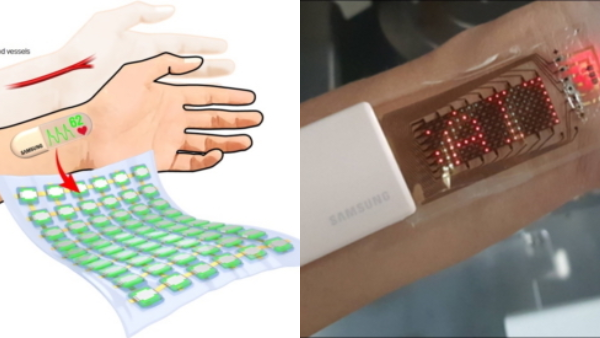
Image via Samsung
Tech companies have been obsessing over every little possibility with flexible displays—and Samsung, the maker of perhaps the most recognizable flexible device thus far, the Galaxy Fold—is literally bending boundaries by creating a “stretchable electronic skin” for potential wearables of the future.
The technology, which is still in its early days, consists of an OLED skin display, with a heartbeat monitor, that can be stretched by up to 30%. In spite of this, measurements taken by its built-in monitor remain precise and consistent—even more so than those recorded by some existing wearable devices, Samsung says.
In their experiments, researchers from Samsung’s research and development wing, the Samsung Advanced Institute of Technology (SAIT), noted that the electronic “skin” displayed accurate results even after being extended to 1,000 times its length. The study’s findings were peer-reviewed and published in the Science Advances journal.
What’s also impressive is that this wearable is designed to work better with movement, so it’s in its element when attached to the wearer’s skin. The team found that it was able to detect a heartbeat signal 2.4 times stronger than a fixed silicon sensor can.
You’ve seen how susceptible foldable displays, like the Galaxy Fold, are to wear. To fix this shortcoming, the team swapped the plastic typically used in stretchable displays with elastomer, a sophisticated material with high elasticity and resilience, to boost its durability.
What elastomer lacks is a resistance to heat—a necessary feature especially when you’re out for a run and need to glance at your heart stats. To overcome this, the researchers modified the material’s molecular composition. And to prolong the device’s lifespan, cracked metal—a stretchable electrode material—was applied to the elastomer component to prevent the OLED pixels from getting deformed.
The researchers are working on ways to extend the device’s “resolution, stretchability, and measurement accuracy” for mass production. Beyond wearing your heart on your wrist, they also hope to bring flexible displays to readings for blood pressure, peripheral oxygen saturation, and electromyogram tests.
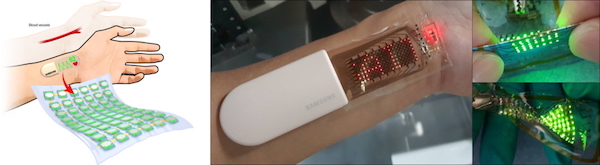
Image via Samsung
[via Engadget, images via Samsung]
Also check out these recent news


