
AI Can ‘Paint’ Entire Surreal 3D Artworks With Only A Word Of Your Choice
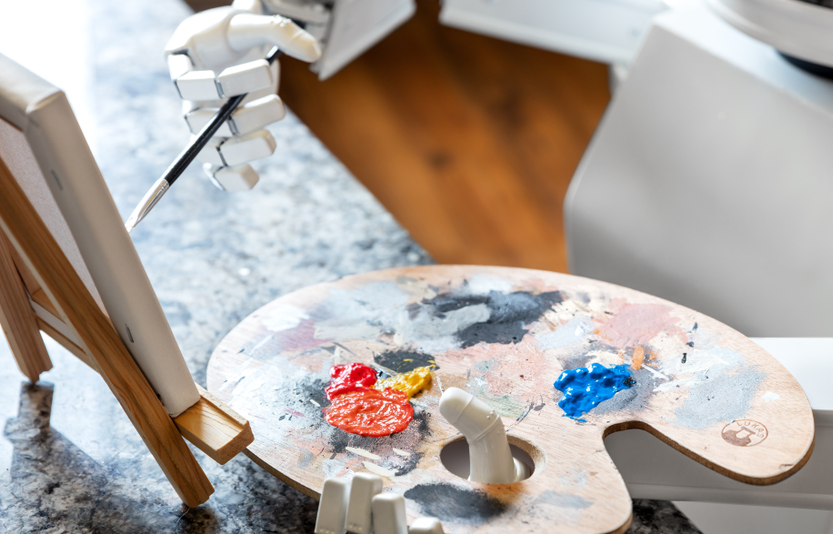
Image via Shutterstock
Enter another addition to the ever-growing list of things that could become fully automated, including nails and boba: art. Specifically, pieces that can be created with just a simple phrase or sentence. Even more specifically, pieces created using image-classifying software enhanced by hackers.
In January, OpenAI announced the introduction of an image-classifying AI, ‘CLIP’. This was the same company behind GPT-3, which was rolled out in May last year, which had the ability to generate extremely human-like text just from a simple prompt. CLIP was designed to match image to text; so entering the word “book” would deliver an image of a book. OpenAI describes it as “part of a group of papers revisiting learning visual representations from natural language supervision in the past year.”
However, some saw greater potential in the software. This March, Ryan Murdock, a machine learning artist, engineer, and hacker, managed to successfully connect CLIP and another AI, VQ-GAN. He then worked on it until it could produce the high-quality images that it does today.
GANs, or generative adversarial networks, were the most powerful image generation tools available to the public previously. After the networks undergo “training,” they can generate new images that are similar to those they were trained with. However, they’re unable to generate images from prompt alone, which is where CLIP comes in.
Twitter user @images_ai shared a tutorial on how to use the combination of software. Ever since the art and machine learning communities caught wind of Murdock’s discovery, a large collective of slightly surreal, but still stunning, 3D work has been produced.
`melancholia` pic.twitter.com/P8vhd6KRoO
— Adverb (@advadnoun) July 11, 2021
"alien friend by thomas kinkade" pic.twitter.com/IaQx6NjeMO
— Rivers Have Wings (@RiversHaveWings) July 10, 2021
So, I've been playing with Twitter's hot new tool, VQ-GAN+CLIP. Mixed results, but I really like at least one - potential art for my own story, "To the Wild Sea" - about heartache and loss on an alien planet, and based on a poem in the story.#SFF #Art pic.twitter.com/6zaozarns6
— MetaphorosisMagazine (@MetaphorosisMag) July 12, 2021
[via VICE, cover image via Shutterstock]
Also check out these recent news


