
Perseids—The Year’s Most Vibrant Meteor Shower—Begins This Week: How To Spot It
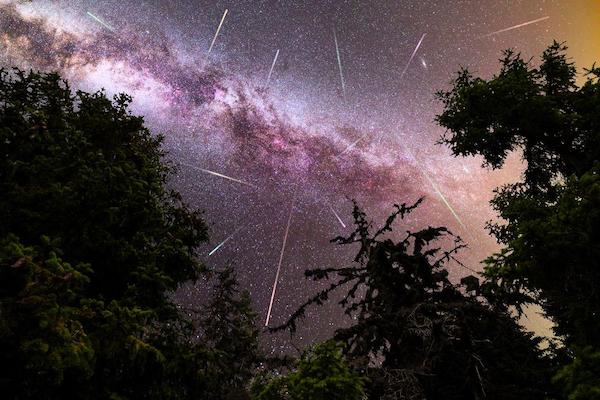
Image via Shutterstock
July 14 marks the start of the annual meteor shower, the Perseids, which spans all the way up to the end of August. It’s scheduled to peak in mid-August this year, with August 11, 12, and 13 being the days—or nights—to watch.
Best viewed in the Northern Hemisphere during the pre-dawn hours and the Southern Hemisphere around midnight, Perseids often leave streaks of light and color behind them as they shoot through the Earth’s atmosphere, according to NASA. They’re also known for leaving fireballs, or larger explosions of light originating from cometary material, in their wake.
In favorable conditions, anywhere from 50 to 100 meteors can be sighted in just one hour.
The meteors get their name from the constellation Perseus, which is their radiant – the point in the sky where the Perseids appear to originate from. However, this doesn’t indicate their origin. They’re actually formed of space debris, left behind by comet 109P / Swift-Tuttle. Discovered in 1862 by Lewis Swift and Horace Tuttle, the comet orbits the sun once every 133 years, with a nucleus of 16 miles in diameter. That’s twice the size of the object which wiped the dinosaurs.
To be able to see an optimal amount of meteors during the shower, EarthSky suggests giving yourself an hour at minimum in between midnight and dawn to observe the sky in moonlight, but positioning yourself in the moon’s shadow.
Although the shower peaks on the mornings of August 11, 12, and 13, meteors usually begin peppering our skies from this week onwards, and 10 days after the peak.
[via CBS News, image via Shutterstock]
Also check out these recent news


