
WhatsApp Can Soon Be Used On Other Devices Even When Your Phone Is Dead

Image via Facebook Engineering
It’s been a long time coming, but WhatsApp has just announced its plans to roll out seamless multi-device support, allowing users to send text messages without the need to sync up their smartphones.
The new function keeps WhatsApp running on up to four other devices at the same time as your phone, but unlike before, the messaging app still works if the main phone is disconnected, or dead. And, the now-standard end-to-end encryption, which will be the default for phones, has been extended to the other platforms, too.
This is no easy feat, considering all data—including information like contacts, archives, and starred messages—have to be synced across all devices, too. Since end-to-end encryption works to ensure that not a single message can be intercepted between sender and receiver, syncing doesn’t operate as easily as it might seem. It doesn’t come as a surprise that this feature is considered incredible rare in today’s messenger market.
The catch, although existent, is minor. As TechCrunch reports, the range of devices users log into just can’t have another phone in it.
“Each message is individually encrypted using the established pairwise encryption session with each device. Messages are not stored on the server after they are delivered,” WhatsApp parent company Facebook wrote in its press release.
“Prior to our introducing multi-device, everyone on WhatsApp was identified by a single identity key from which all encrypted communication keys were derived. With multi-device, each device now has its own identity key.”
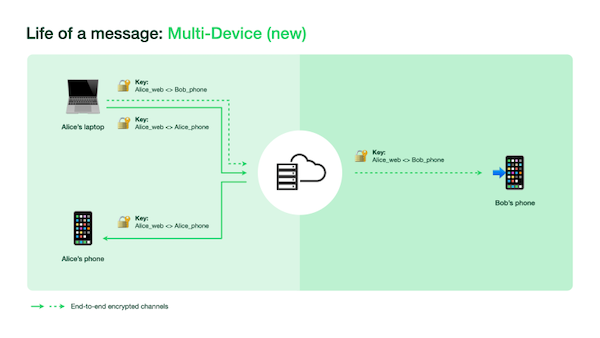
Image via Facebook Engineering
Elements like group calls, live location, statuses, and media attachments are also encrypted, as detailed in the whitepaper.
This feature is part of WhatsApp’s beta program, and is being tested with a small select group. It will reach the public and become more widely distributed, however. More information can be found on the WhatsApp help center.
We believe people have a right to a private conversation because when privacy is guaranteed it’s easier to be yourself and connect safely. That's why end-to-end encryption is at the core of what we do. 🧵1/
— WhatsApp (@WhatsApp) July 13, 2021
[via Forbes, images via Facebook Engineering]
Also check out these recent news


