
Watch: NASA Gives You A Front-Row Seat Aboard Juno, Past Jupiter & Ganymede
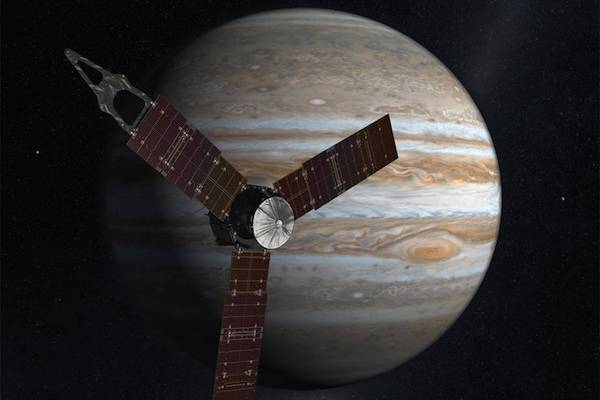
Image via NASA/JPL-Caltech
The Juno spacecraft was launched almost 10 years ago, in August 2011. With a mission to reach Jupiter that was accomplished in 2016, Juno has been providing images of the planet and its surroundings to us since then. But now, NASA has just released a video that gives us a glimpse into what it’s like to be there in the cockpit as the “starship captain.”
“Juno will investigate the existence of a solid planetary core, map Jupiter's intense magnetic field, measure the amount of water and ammonia in the deep atmosphere, and observe the planet's auroras,” writes NASA on Juno’s mission page. The information will enable scientists to study how giant planets form, and their role in the solar system.
Jupiter is the planet with the largest, most powerful magnetic field of all the planets in our solar system. Although it has many moons, the icy Ganymede is the largest in our solar system and the only moon with its own magnetic field.
On June 7 this year, the probe flew closer to Ganymede than any spacecraft had in two decades, reports NASA. Then, it made another glorious flyby of the vast planet in less than three hours.
Compiling the subsequent imagery captured by the JunoCam imager, the mission team created a three-and-a-half-minute-long animation to provide us with a closer insight to Jupiter than ever before. The camera’s point of view was created by scientist Gerald Eichstädt, using composite images of the planet and its moon.
When it captured the images, Juno was traveling at around 41,600 miles per hour. But as it neared the Jupiter, the planet’s gravitational pull took it up to almost 130,000 miles per hour. Although the video is only a few minutes long, it actually took it almost 15 hours to traverse the 735,000 miles between Ganymede and Jupiter.
And now, thanks to its efforts, we get a front-row seat to one of the solar system’s many wonders. Everybody say, ‘“Thank you, Juno.”
Set a course for Ganymede: in June, our #JunoMission flew closer to Jupiter’s giant, icy moon than any spacecraft in more than two decades, then made its 34th flyby of Jupiter itself. For a “starship captain” point of view, enjoy this animation. Details: https://t.co/oZau5ZlrVQ pic.twitter.com/T94hcUnBbr
— NASA Solar System (@NASASolarSystem) July 14, 2021
[via Business Insider, image via NASA/JPL-Caltech]
Also check out these recent news


