
SpaceX & NASA To Explore Jupiter’s Moon As Possible Home For Humans
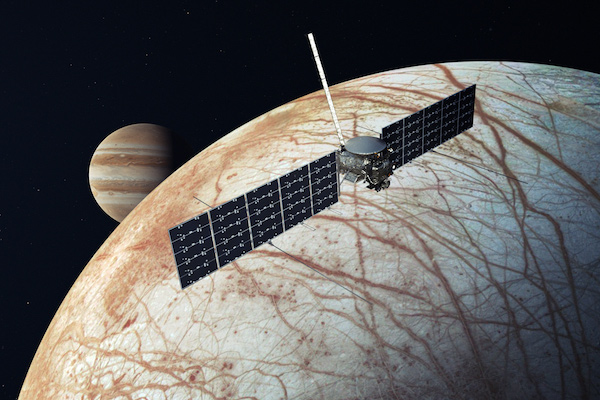
Image via NASA / JPL-Caltech
The Jovian icy moon of Europa might have the potential to support human life. To confirm this, NASA has been wanting to send a probe there and was ultimately able to finalize its plans in 2019.
Now, newly announced, NASA reports that it’s ready to launch its Europa Clipper spacecraft in October 2024 on the back of Elon Musk’s SpaceX Falcon Heavy rocket. This contract will cost approximately US$178 million. While it might not seem like it, it’s actually quite the bargain, compared to what it would've cost to use NASA's Space Launch System (SLS) rocket. (Hint: Congress said US$2 billion.)
Additionally, the SLS would’ve required gravity assist and around US$1 billion for modifications to be able to complete the mission. Enter the Falcon Heavy: it doesn’t need gravity assist, can carry the probe, and can get the job done.
The mission is planned with a main goal: “determine if Europa harbors conditions suitable for life.” The Clipper will carry with it a “suite of advanced instruments” to explore its composition with, such as imagers. Gravity, atmospheric dust, and its magnetic field are also among the areas to be investigated, as well as a hunt for water.
Other objectives include obtaining “high-resolution images of Europa's surface” and detecting “signs of recent or ongoing geological activity.” The team also hopes to learn more about the moon’s icy shell and ocean.
Europa Clipper is planned for an October 2024 launch from Launch Complex 39A at NASA’s Kennedy Space Center, Florida. If that all goes to plan, it’s estimated to reach Jupiter’s orbit in April 2030, just over five years.
[via Engadget, image via NASA / JPL-Caltech]
Also check out these recent news


