
Planet Spotted Making Its Own Moon In Historical First, 400 Light Years Away
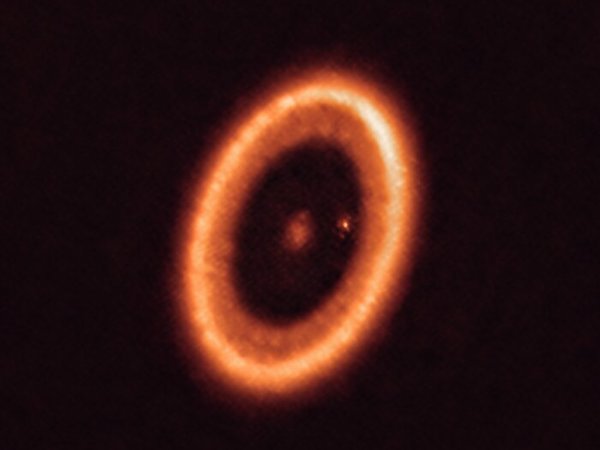
Image via ESO
Astronomers at the University of Grenoble and the University of Chile have discovered an alien moon in the making for the first time in history. Almost 400 light-years away, two Jupiter-esque planets orbit a star, a system called PDS 70. One of those planets is in the process of forming its own moon.
A partner of the European Southern Observatory (ESO), the Atacama Large Millimeter/submillimeter Array (ALMA)’s radio dishes captured a ‘ring’ surrounding the planet PDS 70c, which is precisely in line with how it is believed that moons are formed. Although hints of this were detected previously, the disc was still in early forming stages and was hard to differentiate from its environment. However, now, there is a much clearer picture.
“Our ALMA observations were obtained at such exquisite resolution that we could clearly identify that the disc is associated with the planet and we are able to constrain its size for the first time,” Myriam Benisty, a researcher on the team, explains in the press release.
When a planet is formed around a star, it takes in material from its surroundings to grow, acquiring its own disc in the process. This contributes to the growth of the planet, as well as allowing for a series of ‘collisions’ between gas and dust within it, leading to a new moon being born.
PDS 70c’s moon-creating halo is approximately the distance between the Earth and the Sun, according to the research published in The Astrophysical Journal Letters. In other words, it’s 500 times bigger than Saturn’s rings. And, there exists enough material in the disc to form three moons, each being the same size as the Earth’s moon.
But that’s not all: the star which is orbited by PDS 70c also has its own disc. That material could potentially form new planets, which could then form new moons… and the cycle goes on, bound only by space and time.
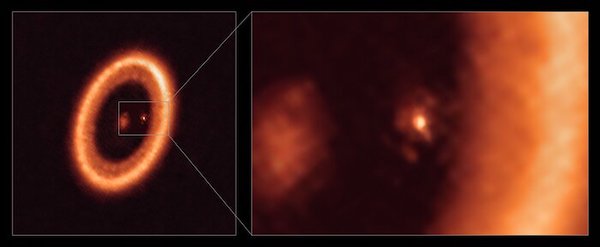
Image via ESO
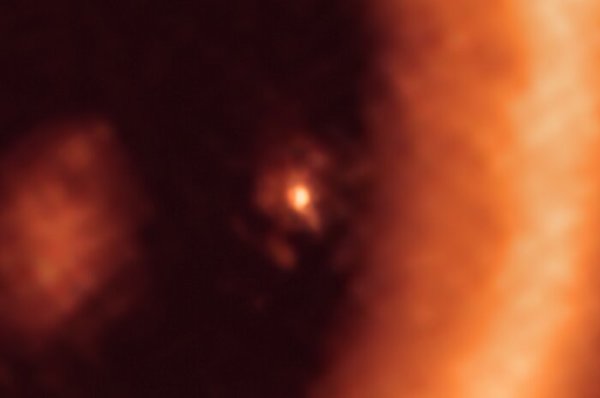
Image via ESO
[via Business Insider, images via ESO]
Also check out these recent news


