
Rare Piggy Bank Is Unearthed In Ancient Greek City After 15 Centuries
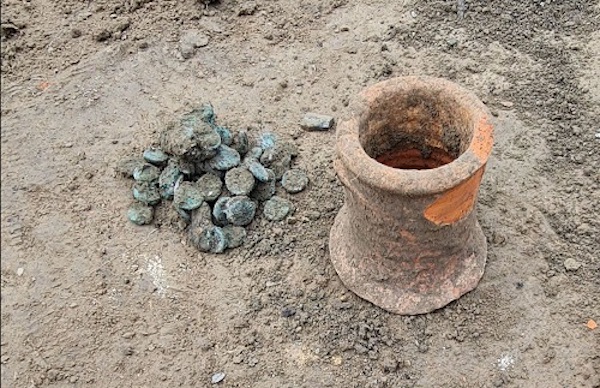
Image via Institute of Archeology of the Russian Academy of Sciences
In today’s southwestern Russia, an ancient Greek city called Phanagoria used to thrive. It flourished during the fifth to second centuries BC, and was populated largely by Sindians, Maeotians, Sarmatians, and Greeks. After dying out in the 11th or 12th century AD, it began to undergo excavations in the 19th century.
Archaeologists at the Institute of Archeology of the Russian Academy of Sciences made the discovery when examining what still remains. In the announcement, the Institute states that a total of 80 copper staters (type of Greek coin) were found in an amphora, which had been buried for centuries. Researchers believe that this stash was stuffed into in the jar in the incoming of an attack, most probably from the Huns or Turks, which caused a large part of the city to burn to ashes.
This trove was rescued from a layer of debris that also revealed the singed remains of wooden floors, dishes, and broken baptismal font. The last item signals towards a Christian basilica potentially being one of the buildings which succumbed to the flames.
Vladimir Kuznetsov, who leads the Institute’s excavation efforts, explains the most probable scenario in which the coins were hidden: when the attack descended, the resident of Phanagoria stashed the coins away into the throught of an old, unassuming amphora. Then, they buried it under the Earth, possibly with plans to return for it later. Unfortunately, they never did.
A gold coin made during the fifth century AD reign of Byzantine emperor Justinian I was discovered at the same site in 2019. It was believed that the coin was also lost due to a sixth century fire, allowing the team to conclude the happenings of two separate fires.
Apart from just being an unexpected, thrilling find, the coins also serve as understanding of how the economy worked at the time. As these coins were made from copper instead of gold like the former, it can be deduced that there were hierarchies to the currency’s value in which material had a part to play.
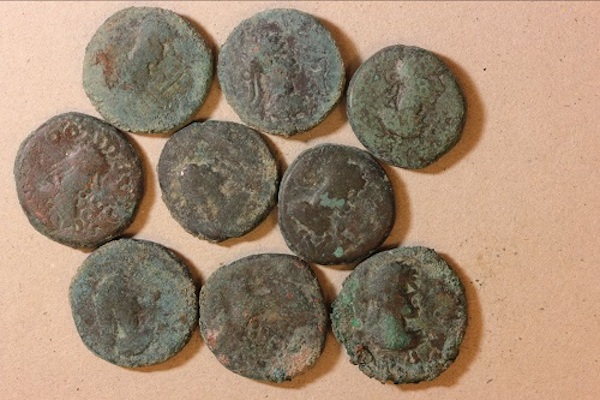
Image via Institute of Archeology of the Russian Academy of Sciences
[via Artnet, image via Institute of Archeology of the Russian Academy of Sciences]
Also check out these recent news


