
Forget Rockets, Scientists Are Sending A Telescope To Space Via Helium Balloon
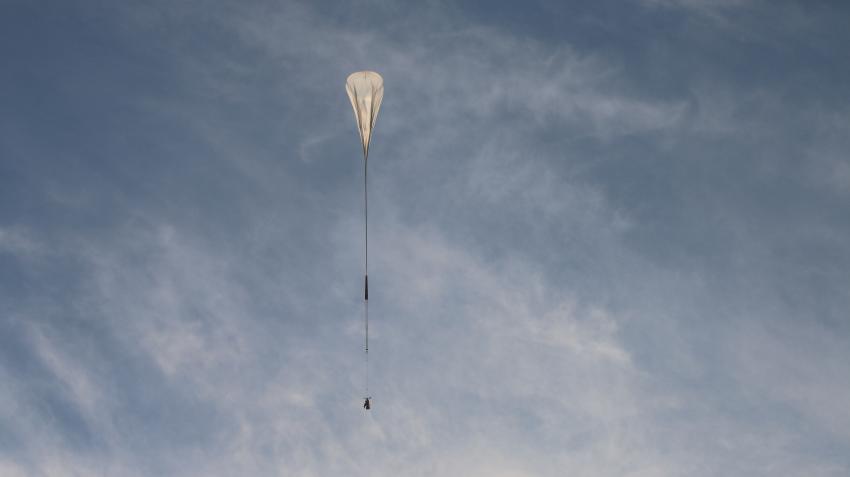
Image via Richard Massey / Durham University
Just because a piece of equipment is high-tech and cost a lot doesn’t mean that it will definitely be successful, especially in the unchartered territory of space travel. This is perhaps why a team of scientists have decided to come up with an innovative, cheaper, more flexible way of launching things into space.
Universities from Durham, Toronto and Princeton have teamed up with NASA and the Canadian Space Agency (CSA) to come up with a new astronomical telescope: the Super-pressure Balloon-borne Imaging Telescope, otherwise endeared as the SuperBIT. It voyages merrily above 99.5% of the Earth’s atmosphere, hitching its ride from a helium balloon which has a volume of 532,000 cubic meters (140,539,532 gallons). In other words, a helium balloon the size of a stadium.
“Its final test flight in 2019 demonstrated extraordinary pointing stability, with variation of less than one thirty-six thousandth of a degree for more than an hour,” announces the National Astronomy Meeting’s press release. “This should enable a telescope to obtain images as sharp as those from the Hubble Space Telescope.”
The budget for construction and operation for the first telescope was US$5 million, which the statement reports is almost a thousand times less than a similar satellite. Due to its unique balloon-launch strategy, the SuperBIT will be able to return to Earth and be relaunched, too, saving costs and the environment in terms of not using rocket fuel. The telescope can also then be tweaked and upgraded between flights.
But can a singular balloon withstand the test of time, space, and pressure? It’s “exceedingly difficult.” the team admits. But NASA’s recent development of the ‘superpressure’ balloons swoop in here to save the day, with their ability to contain helium for months.
SuperBIT is scheduled to launch next April from Wanaka, New Zealand. It’ll go on a world tour a couple of times, imaging the sky at night and recharging its solar-powered batteries in the day. At least with the balloon around, it won’t get lonely.
[via Slate, image via Richard Massey / Durham University]
Also check out these recent news


