
Newly Unearthed Ancient Roman Road Suggests Venice Is Older Than Thought
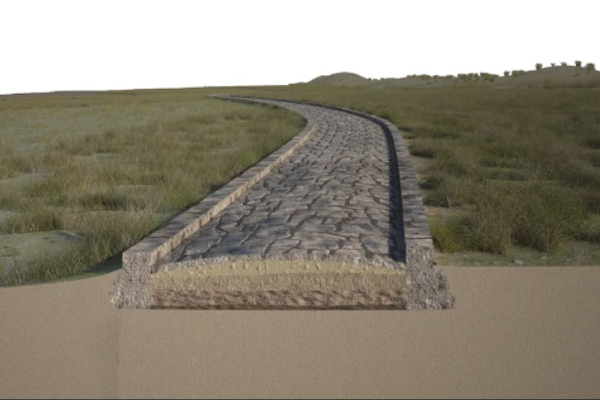
A 3D recreation of what the road could have looked like. Image via Madricardo, F., Bassani, M., D’Acunto, G. et al (CC BY 4.0)
In the ancient Roman empire, stone-paved roads were crucial to commerce and government, transporting goods and people to and from their destinations. Many such routes have long perished and disappeared with barely a trace left behind, but a recent discovery in Italy uncovers a bit more about the settlers in Venice.
A team led by Fantina Madricardo at Venice’s Institue of Marine Science (ISMAR) unearthed a lost stretch of road while investigating the rising sea level of Venice. Using sonar technology, the team created a 3D map of the floor of the Venice Lagoon without needing to submerge themselves into the waters. One discovery made was a cluster that is believed to be the piers of what used to be a Roman dock, reports Sci-News.
12 structures were found 13 to 16 feet below the surface, some of them spanning more than 100 feet. Upon this discovery, police divers decided to go underwater to explore them further, bringing cameras with them. Footage captured on this expedition showed a winding section made from smooth paving stones, which was later recognized as the surface of a classic Roman road.
Venice is thought to have been linked to the Roman town of Altinum via this road. That’s a bit of a puzzling discovery, if you consider the fact that Venice was always believed to have been founded in the fifth century CE, following the fall of the Western Roman Empire.
However, this finding and discovery of the port indicate that there was already a settlement in the Treporti Channel, where Venice now is located, during Roman times. Venice and the Roman Empire could’ve coexisted together. The migration to Venice is now described as a “more gradual process” by Madricardo in the published research, instead of the sudden movement that was previously assumed.
This path and its surrounding structures would’ve been usable above ground around 2,000 years ago, attesting to the effects of the rising sea levels worsened by global warming.
There may be more undiscovered treasures left hidden, sunken beneath the surface. The road to Venice is only one of them.
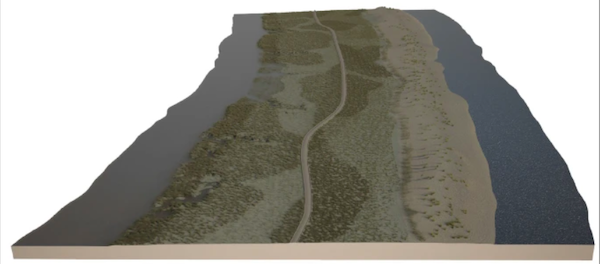
Image via Madricardo, F., Bassani, M., D’Acunto, G. et al (CC BY 4.0)
[via My Modern Met, images via Madricardo, F., Bassani, M., D’Acunto, G. et al (CC BY 4.0)]
Also check out these recent news


