
Scientists Discover Potentially Habitable Planet In Another Solar System
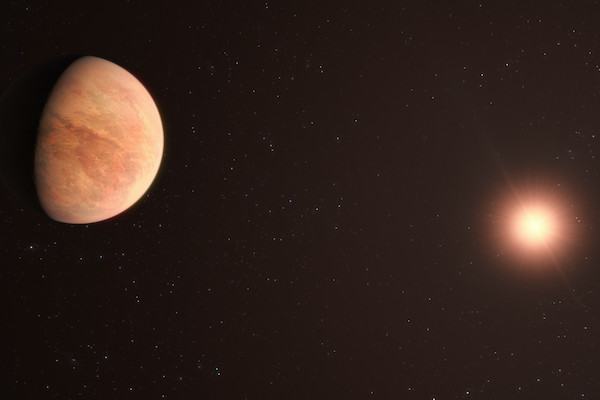
Image via ESO/M. Kornmesser
Just 35 light years away from us, there lies a planetary system pretty similar to ours. So similar, in fact, that there’s another potentially habitable planet there, just like our planet Earth.
Scientists used the European Southern Observatory’s Very Large Telescope (ESO’s VLT) in Chile to study the planets around a nearby star, called L 98-59. This system of a star and three (so far) planets is reminiscent of our own, and the study of it was published in Astronomy & Astrophysics.
The three planets include an ocean world, one with half the mass of Venus, and, last but not least, one planet in the star’s habitable zone—the one that has piqued the most interest.
The latter “may have an atmosphere that could protect and support life,” says María Rosa Zapatero Osorio, an astronomer at the Centre for Astrobiology in Madrid and co-author of the study, in an ESO statement.
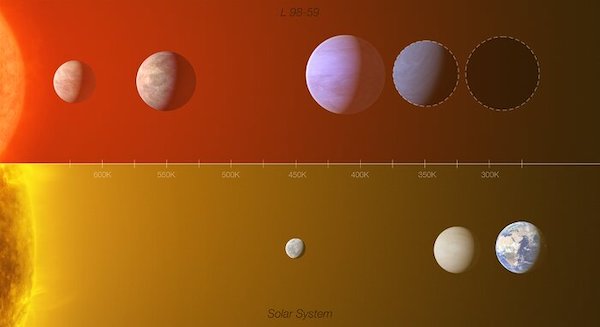
Image via ESO/L. Calçada/M. Kornmesser
Here’s what we know so far:
• These three planets may have water in either their interiors or atmospheres.
• The one closest to the star (L 98-59a) has half of Venus’ mass.
• An estimated 30% of the one furthest from the star, L 98-59c, could be water, hence being dubbed the ‘ocean world’.
• There is a fourth planet, L 98-59d, but not much is known about it.
• And a fifth planet is suspected, where there may be liquid water, as it’s at the right distance from the star for it to exist.
Alongside the VLT, researchers have also been using the exoplanet-hunting ESPRESSO instrument. When the James Webb Space Telescoped is launched in October this year, it will also be used to study L 98-59. And when the Extremely Large Telescope (ELT) is ready to go in 2027, it will be used to do so as well, according to Forbes.
“This system announces what is to come,” declares Olivier Demangeon, a researcher at the University of Porto, Portugal, and lead author of the new study.
“We, as a society, have been chasing terrestrial planets since the birth of astronomy and now we are finally getting closer and closer to the detection of a terrestrial planet in the habitable zone of its star, of which we could study the atmosphere.”
[via Geo News, images via ESO]
Also check out these recent news


