
This Ice-Age Lion Cub Is Frozen In Time With Fully-Intact Fur, Organs, Skin

Image via G. Boeskorov et al / Quaternary (CC BY 4.0)
‘Sparta’ is the nickname of a lion cub who looks like it’s just taking a nap, and one sudden movement could startle her awake. The only thing is, the nap has lasted 28,000 years so far, and it doesn’t look like the cub will be waking anytime soon.
Found frozen in permafrost in the Siberian arctic alongside another baby cave lion, Sparta’s whiskers, teeth, skin, and fur are all still intact. Although matted with mud, the fur retains its golden hue. All internal organs remain, too, albeit mummified. And, her claws are still sharp enough to leave a scratch.
The study published in Quaternary writes that the cub, and a second found near her, were preserved in such impeccable condition due to their surroundings.
“Maybe the cubs were buried under the ground following a landslide, and their bodies were deformed by the earth’s mass and permafrost features and froze quickly to become mummies.”
It’s speculated that they perished in their den, possibly while waiting for a parent to return with food. The den would’ve been under the snow or under the Earth, which explains “why predators and scavengers did not find their bodies, and that is why we do not see any damage on the mummies that could have been inflicted by them.”
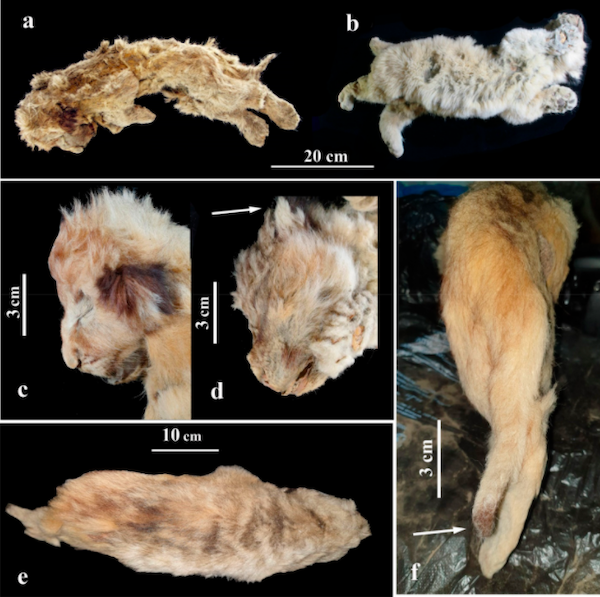
Image via G. Boeskorov et al / MDPI (CC BY 4.0)
CNN reports that the two cubs were first believed to have been siblings, but radiocarbon dating shows that the second cub, Boris, is 43,448 years old, which is around 15,000 years older than Sparta. He’s not as well-preserved, but still in better condition than most animals are found in.
Both of them were only a couple of months old when they died, and the cause of death is unknown. The team details that there were no signs of predatory attacks, but tomography revealed “skull damages, ribs dislocation, and other distortions in their skeletons.” This, however, may have been due to the Earth’s pressure.
Analysis of the fur revealed that the cave lions, a species that roams the Earth no more, didn’t have “vivid dark spots” on their bodies when they were cubs, which is a typical feature of the P. leo cub, today’s African lions. The cubs also yielded a long thick undercoat of fur, which helped them in the harsh cold climate of Siberia.
Here is a wider shot... pic.twitter.com/XhUbia37gE
— Love Dalén (@love_dalen) February 22, 2019
[via Boing Boing, images via G. Boeskorov et al / MDPI (CC BY 4.0) and Love Dalén]
Also check out these recent news


