
Exploded Getaway Star Is Hurtling The Wrong Way, Out Of Galaxy At 2 Million MPH
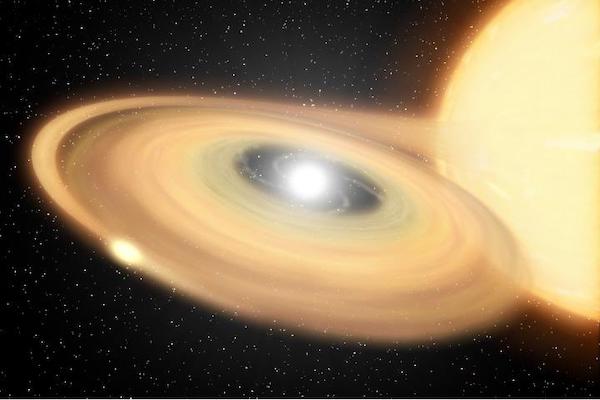
Image via NASA/JPL-Caltech
LP 40-365 was a star discovered in 2017 to have been escaping the Milky Way at almost two million mph, which is around four times as fast as the orbit of the Sun. Most stars move in roughly the same direction, but this one is clearly built a little differently.
It’s a star that has exhausted its supply of nuclear fuel and discarded its outer layer, retaining only its core, which often exceeds a temperature of 100,000 Kelvin. This is otherwise known as a white dwarf.
New analysis, published in The Astrophysical Journal Letters, has now revealed more about LP 40-365. Studying its attributes led to the conclusion that it had been flung across space by a supernova.
Rather than the usual elements of hydrogen and helium, this star only contained heavier ones such as oxygen, neon, and magnesium, which astronomers conclude must have been contributed by the supernova.
This also leads to the conclusion that LP 40-365 was once half of a pair of white dwarfs, which explode as soon as they’ve gleaned enough mass from their partner. An explosion like this has enough power to fuse nuclei into new elements altogether.
Live Science details the two probable scenarios that led to this. A first possibility is that one star exploded “cleanly,” an event that could have infused its partner with heavy metals and sent it hurtling out into the unknown. Or, a fragment of the exploding star escaped the supernova, taking with it the metals which were forged in the explosion.
Although the star doesn’t have its own planet, it does have a rotational pattern of dimming and brightening every 8.9 hours. This leads the team to believe that the star spins, therefore bringing sunspots into view every now and again, as study lead author J.J. Hermes describes.
Studying its rotational patterns is crucial in finding out what happened to this unconventional piece of our galaxy. If it was the companion of the white dwarf that exploded, it would spin much faster than LP 40-365’s leisurely pace. Since the rotation period lasts more than one week, it suggests that it’s a fragment of the exploded original star.
LP 40-365, described aptly in the study as a “partly burnt runaway star,” has certainly put its own spin on things.
💫 THREAD: Let's talk for a second about one of the weirdest stars in our Galaxy. We don't have long -- it's moving so fast it's escaping the Milky Way! It's also the most metal-rich star known, a hunk of neon and oxygen hurtling through space, SHRAPNEL FROM A SUPERNOVA! (1/9) pic.twitter.com/GLjuqbD3Tv
— JJ Hermes (@jotajotahermes) May 17, 2021
[via Live Science, image via NASA/JPL-Caltech]
Also check out these recent news


