
'Closest We Have To Dragons’: This Is Australia’s Jaw-Dropping Ancient Pterosaur
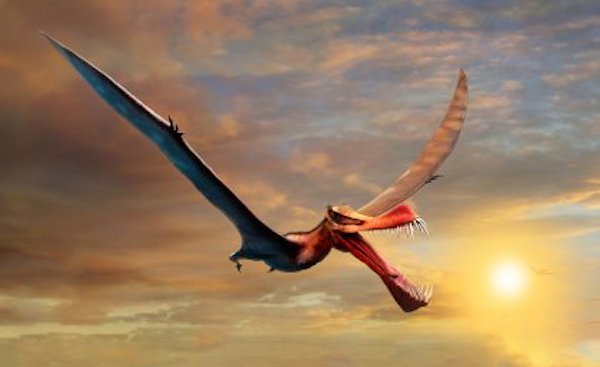
Image via University of Queensland
Imagine looking up at the sky and seeing a winged beast with a huge jaw flying directly above you. When you’re a small dinosaur, that’s practically a death sentence.
With a wingspan of an estimated 7 meters (23 feet) and a very unconventional silhouette, it’s no wonder the researchers who discovered this fossil have equated it to a dragon, or the “closest thing we have” to one, and for good reason.
A fossil of this creature’s astounding jaw was found in June 2011 in Wanamara County, near Richmond in Northwest Queensland, Australia. The pterosaur was named the Thapunngaka shawi, and was painted to be a rather terrifying sight by the researchers in Tuesday’s statement.
“This thing would have been quite a savage,” says University of Queensland PhD candidate Tim Richards, and leader of the study published in the Journal of Vertebrate Paleontology. “It would have cast a great shadow over some quivering little dinosaurs who wouldn’t have heard them coming until it was too late.”
Described in the study to be Australia’s largest pterosaur yet, the Thapunngaka shawi was found to be essentially “just a skull with a long neck, bolted on a pair of long wings.” Pterosaurs were the first animals with a backbone to try their hand at powered flight, according to the University.
Having adapted to flight, this species of dinosaurs had relatively hollow bones, which makes their fossils already rare to find, but also often in bad condition. As Richards states, “it’s quite amazing fossils of these animals exist at all.” This one is thus a welcome exception.
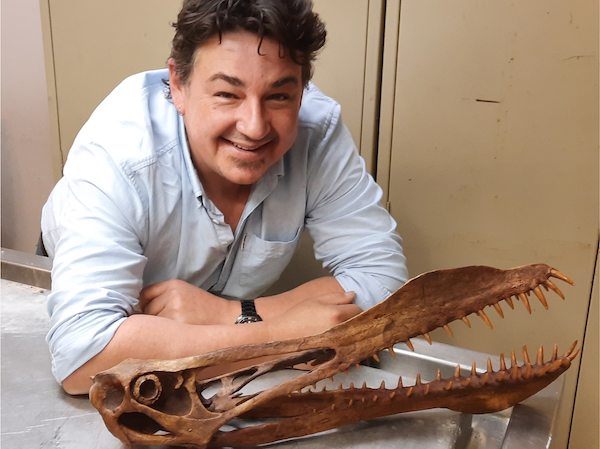
Image via University of Queensland
The genus name of the newly-discovered dinosaur is a tribute to the First Nations peoples of the Richmond area, where the fossil was found. Thapunngaka is made by integrating words from the language of the Wanamara Nation. Specifically, ‘thapun’ and ‘ngaka’, the Wanamara words for ‘spear’ and ‘mouth’ respectively, according to Dr Steve Salisbury, co-author on the paper and Richards’ PhD supervisor.
The species name, shawi, honors Len Shaw, a local fossicker who was the one to find the fossil. The name therefore means ‘Shaw’s spear mouth’. Pretty fitting, when you look at the size of that mandible.
The jaw-dropping fossil of the Thapunngaka shawi has now been put on display at Kronosaurus Korner, Richmond.
[via CNET, images via University of Queensland]
Also check out these recent news


