
Saturn Has A Fuzzy Wobbling Core & Makes Ripples In Its Rings, Research Reveals
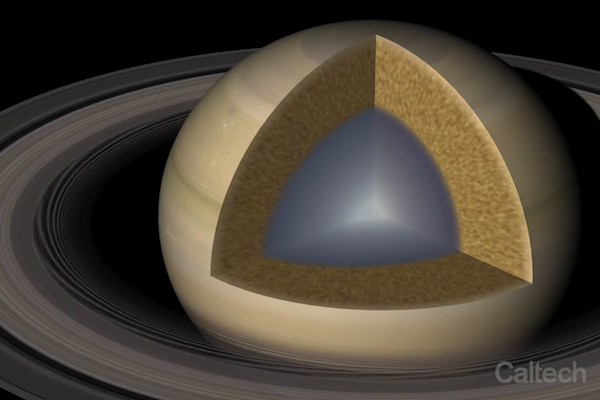
Image via Caltech
Admittedly, the words “fuzzy” and “wobble” aren’t the most associated with planets, but these new discoveries of Saturn’s behaviors might just change that.
Upon its decommissioning, NASA’s Cassini made its farewell approach to Saturn and hurtled itself into the planet’s atmosphere on September 15, 2017, disintegrating to become part of it. It reported data all the way down, until loss of contact was established.
The findings were studied by Christopher Mankovich and Jim Fuller, astronomers at the California Institute of Technology (Caltech). Their observations, published in Nature Astronomy, revealed that Saturn's core is 55 times larger than our entire planet, and is “fuzzy” from gas.
Oscillations within Saturn cause the planet to wobble, like earthquakes on Earth. These generate ripples in the planet’s rings. The frequency of the gravitational ripples indicates that Saturn’s deep interior is stable, due to its formation—heavy materials, like ice and rock, move toward the planet’s center while light materials rise.
An area of the core approximately 17 times the Earth’s mass is made of ice and rock. The rest is a fluid made of hydrogen and helium, making up the “fuzzy” core. This part extends across 60% of the planet’s diameter, much larger than formerly believed.
It was also previously thought that the planet’s core was solely a “hard ball of rock” instead of the “diffuse soup” it’s now known as.
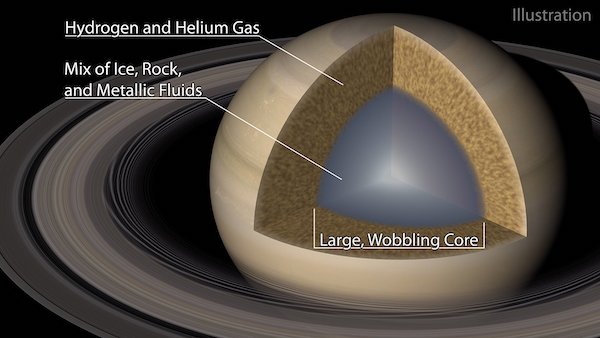
Image via Caltech
“The fuzzy cores are like a sludge,” Mankovich says in the statement. “The hydrogen and helium gas in the planet gradually mix with more and more ice and rock as you move toward the planet’s center.” He compares it to parts of Earth’s oceans, where saltiness increases with depth.
Another finding that further proves this is the way spiral patterns are formed in the planet’s rings due to its oscillations. According to the team, Saturn’s C-ring contained patterns caused by the planet’s gravitational field. These differed from waves in the rings caused by interacting with the planet’s moons.
These results challenge the current models of gas giant formation, which state that rocky cores form first before attracting gas. Now, the “fuzzy core” results show that gas might be incorporated earlier than that.
Kronoseismology: The practice of using Saturn's rings as seismic indicators to better understand what's happening below clouds of obscuring gases.
— Caltech (@Caltech) August 16, 2021
New data gathered through this method has revealed an unexpectedly "fuzzy" core at the planet's center.https://t.co/oP914PUv1u
[via CNN, images via Caltech]
Also check out these recent news


