
Pi Has Been Calculated To Record-Breaking Trillions Of Digits
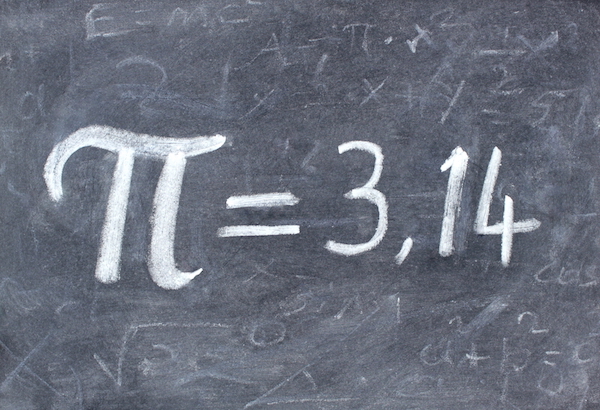
Image via ID 22724000 © Hayati Kayhan | Dreamstime.com
If you ask most people, they’d only remember pi up to 3.1415 at most. Now, researchers in Switzerland have broken the record for the most precise value of the mathematical constant, after calculating the famed number to a staggering 68.2 trillion decimal places.
Pi, the ratio of a circle’s circumference to its diameter, is an irrational number—meaning it has an infinite number of decimal places. Researchers across the globe often try to break the record by finding an even more precise number, and this month, a team from the University of Applied Sciences of the Grisons managed to smash the existing record by more than 18 trillion digits.
They used a supercomputer to calculate the additional digits, and while knowing a more accurate pi isn’t of great importance to mathematics as a whole, it has been often used as a benchmark to test the processing power of computers.
“Breaking the record is just a side effect of our work in preparing our high performance computer infrastructure for work in research and development,” lead researcher, Thomas Keller, told Live Science.
Previously, in 2019, a Google computing system had calculated pi’s value to over 31 trillion decimal places. This record was then broken last by Timothy Mullican, who calculated the constant to 50 trillion decimal places using his personal computer, as per the Guinness World Records.
This time, the team of researchers at the university not only broke the existing record, but also did so in a third of the time. It took only 108 days and 9 hours to hit over 68 trillion decimal places, compared with Mullican’s 303 days, despite using the same algorithm.
“Calculating to 68.2 trillion decimal places requires around 316 terabytes of RAM. Such a machine cannot be bought, to our knowledge, and if one could, it would be extremely expensive,” Keller explained.
Going forward, the researchers plan to use the supercomputer to conduct computational fluid dynamics, deep learning, and RNA analysis.
[via Live Science, cover image via ID 22724000 © Hayati Kayhan | Dreamstime.com]
Also check out these recent news


