
Dinosaur-Era Egg Cracks Open To Reveal Rarely Fossilized Ancient Baby Turtle
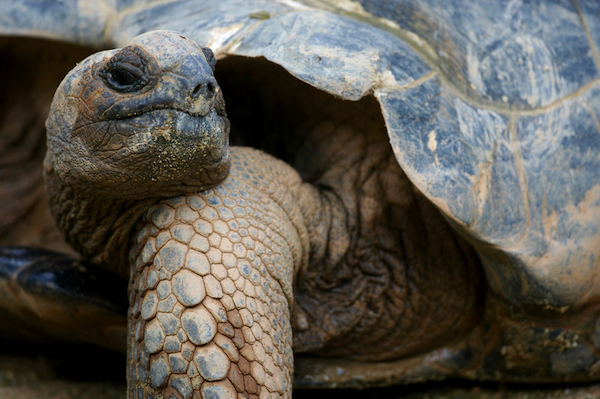
A closeup shot of a turtle. Photo ID 3599763 © Kitchner Bain | Dreamstime.com
In Neixiang County, China, a treasure trove of dinosaur eggs was discovered. Among them was a standout specimen, one unlike any others researchers had seen before.
Initially it was believed that the egg might belong to a new species of dinosaur, given how rare it was. However, cracking it open revealed something perhaps even more exciting: the fossilized embryo of a giant extinct turtle.
Paleontologists from Wuhan’s China University of Geosciences, Fenglu Han and Haishui Jiang, discovered the specimen in 2018. Analysis showed that the embryo belonged to the nanhsiungchelyids group of turtles, whose members walked the Earth alongside the dinosaurs 145 million years ago.
These were huge turtles, and often carried with them a large, thick shell. The team has estimated that the shell length of the turtle who laid this egg is almost that of an average person laying down.
Fossilized remains of any animal embryos are rare, due to the delicate nature of tissues and bones of the animals who aren’t fully developed. These break down easily over time, explains Darla Zelenitsy, co-author of the study, to the National Geographic .
In addition to this, turtle embryos are even more uncommon—most turtle eggs are tiny and have thin shells. This one, however, had a shell with almost four times as much thickness as a turtle belonging to the Galápagos, which is renowned for its thick shell.
Han tells the National Geographic in an email that when the scientists found some other eggs in the same site, none of them were as well-preserved as this one. A CT scan of the egg revealed its contents, which the team then used to virtually piece together a sample of what the turtle hatchling would’ve looked like.
What they found was a specimen that looked pretty much the same as modern turtles, except for a few features that helped to distinguish them. One of these was the upper jawbone, which was the defining feature that allowed scientists to trace it back to the nanhsiungchelyids.
Unfortunately, the turtles’ land-based habitat was the cause of their demise. It’s believed that unlike other sea-dwelling turtles, they were wiped out in that fateful meteor strike alongside the dinosaurs. Survivors would’ve also struggled to find food in the post-impact climate, since they ate only plants.
Only one well-preserved specimen like this has been found, but the discovery of just one is all we need to know that there are more out there, waiting to be unearthed.
There was once a turtle w/ a shell about as long as a human is tall that walked the Earth alongside the dinosaurs.
— Dr. Maya Wei-Haas (@WeiPoints) August 18, 2021
One of these giants laid a clutch of eggs near a river in what is now China. But the babies never made it.
My latest @natgeohttps://t.co/mWVp43bVoT
[via National Geographic, image via ID 3599763 © Kitchner Bain | Dreamstime.com ]
Also check out these recent news


