
Newly-Found Great Barrier Reef Coral Is Its Widest Known Yet At 34 Feet
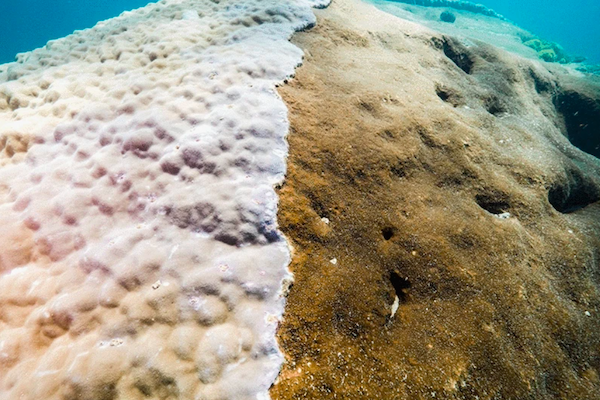
Image via Smith et al / Scientific Reports (CC BY 4.0)
Nestled in the Great Barrier Reef off the Palm Islands, Australia, is the widest coral community in the reef. Discovered in March, it spans just over 34 feet across and 17 feet tall.
The Islands’ traditional custodians, the Manbarra people, have suitably given it the name of Muga dhambi: Big Coral.
Based on its height, the research team led by Adam Smith and Nathan Cook estimates it to be somewhere around 421 to 438 years old. According to them, the coral has survived bleaching, invasive species, cyclones, severely low tides, and human activity for all those years.
This colony is part of the Porites, a genus of stony corals. They’re a crucial type of reef-building coral, as they’re able to provide shelter with their large structures.
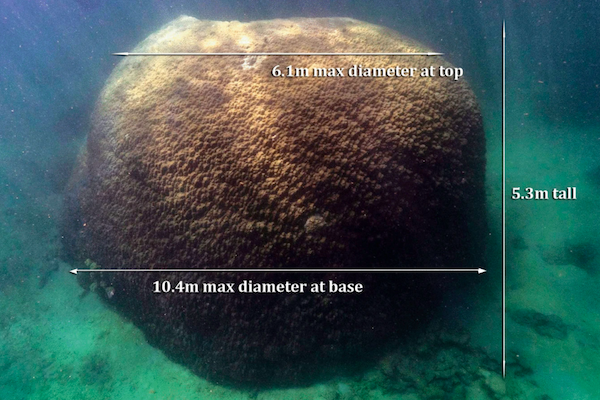
Image via Smith et al / Scientific Reports (CC BY 4.0)
“The large Porites coral at Goolboodi (Orpheus) Island is unusually rare and resilient,” writes the research team in their paper published in Scientific Reports.
Significant environmental events since 1575 include almost a hundred instances of bleaching and up to 80 major cyclones, the team realized. The determined Muga dhambi has survived them all. This is on top of declining water quality as a result of sediment runoff.
However, high-density “stress bands” didn’t go unnoticed within the coral’s structure. These date back to 1877, and their appearances coincide with the patterns observed in anthropogenic global warming.

Image via Smith et al / Scientific Reports (CC BY 4.0)
Currently, it’s mostly inhabited by the colony of living coral polyps, the party responsible for its construction; and algae symbiotes, or zooxanthellate. However, part of its top is void of them, and instead houses sponge algae and other types of coral.
These green sponges are most commonly found on the “most turbulent side of corals,” writes ScienceAlert. Here, they’re exposed to greater currents, which help them to filter water for bacteria and other microbes for sustenance.
Researchers warn that “the sponge’s advances will likely continue to compromise the colony size and health.” This is due to the way coral polyps evict photosynthesizing zooxanthellae under high stress. While it may help to save energy in the short term, the polyps will die from starvation if the algae don’t return.
Despite this rather bleak information, it’s a good sign that the scientists didn’t find any indications that the Muga dhambi was diseased or sustained bleaching.
By monitoring this rare specimen and how it survived all these years, a lot can be learnt. Hopefully, it will inform measures that may save the rest of the corals.
It is 10.5 metres wide, four centuries old, and twice the size of its nearest cousin — meet the “exceptionally large” coral discovered on the #GreatBarrierReef. It was found off the coast #OrpheusIsland. Read more: https://t.co/k2sBr1mdak #scienceweek
— Great Barrier Reef Marine Park Authority (@gbrmarinepark) August 20, 2021
[via ScienceAlert, images via Smith et al / Scientific Reports (CC BY 4.0)]
Also check out these recent news


