
One Of Our Milky Way’s ‘Arms’ Is Broken & Juts Out Awkwardly; No One Knows Why
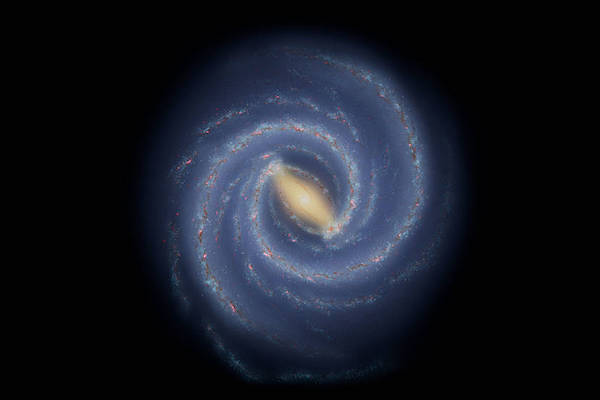
Image via NASA / JPL-Caltech
Using data combined from two space missions, scientists have discovered a “break” in one of our Milky Way galaxy’s arms. Jutting out at an awkward angle, this revelation indicates a whole new aspect of the galaxy that has not yet been uncovered.
As described by Universe Today, mapping our galaxy proves incredibly difficult, seeing as how Earth is in the middle of it. It’s comparable to trying to map out a forest while standing in it.
One of the ways this can be attempted is through measuring the distance of thousands of stars to get an idea. It’s believed that young stars, and the nebulae they are formed in, are closely aligned to the arm where they’re located.
Focusing on the Sagittarius Arm, the team utilized NASA’s Spitzer Space Telescope to scour the sky for newborn stars. Then, it used the latest data release from the European Space Agency’s Gaia mission to measure the distances to the stars.
Its findings, published in Astronomy and Astrophysics, revealed that the lengthy structure sticking out of the Sagittarius Arm is, in fact, made of a cluster of young stars moving through space at nearly the same velocity and direction.
This suggests they were either all formed or affected by some external gravitational force at the same time, ripping them out of their original structure.

Image via NASA / JPL-Caltech
Previously unrecognized, this new feature stretches 3,000 light years and sticks strangely out of the Sagittarius Arm “like a splinter poking out from a plank of wood.” It’s the only major structure to have such a vastly different positioning to the rest of its surroundings.
“A key property of spiral arms is how tightly they wind around a galaxy,” explains Michael Kuhn, an astrophysicist at Caltech and lead author of the new paper, in a statement.
He goes on to say that most models of the Milky Way indicate that the Sagittarius Arm forms a spiral that has a pitch angle of roughly 12º. However, the “broken arm” stands out at almost 60º instead.
The question is “why?” But there isn’t a solid answer, and scientists are still in the dark, too. “There are many uncertainties about the large-scale structure of the Milky Way,” says Robert Benjamin, an astrophysicist at the University of Wisconsin-Whitewater, and paper co-author.
“This structure is a small piece of the Milky Way, but it could tell us something significant about the Galaxy as a whole.”
[via Universe Today, image via NASA / JPL-Caltech]
Also check out these recent news


