
Scientists Discover Fastest-Orbiting Asteroid, Closer To The Sun Than Mercury
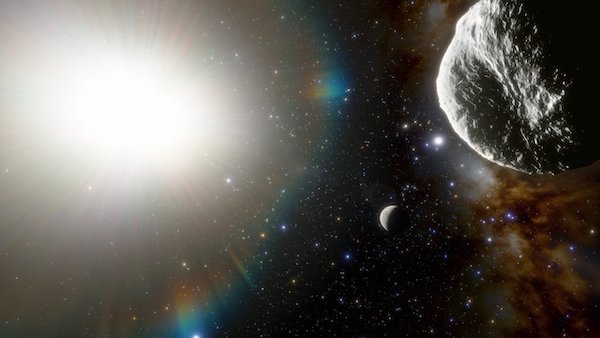
Image via CTIO / NOIRLab / NSF / AURA / J da Silva
Astronomers in Chile have recently found the fastest-orbiting asteroid in our solar system, and it’s closer to the Sun than Mercury.
The asteroid, named 2021 PH27, which is a mouthful, is said to have an elliptical and inclined orbit that crosses paths with both Venus and Mercury.
The space rock is approximately 0.6 miles in diameter, and is within 12 million miles to the Sun at its closest. At that distance, the temperature reaches 900°F — hot enough to melt lead.
According to Forbes, 2021 PH27 won’t be visible from now till early 2022, as its orbit has just gone behind the Sun. Scientists are planning more observations of the space rock for next year, in order to determine its precise orbit, and officially change its name to something more memorable.
This discovery is also relevant to us on Earth, as uncovering such asteroids enables astronomers to determine which of them could one day impact the planet.
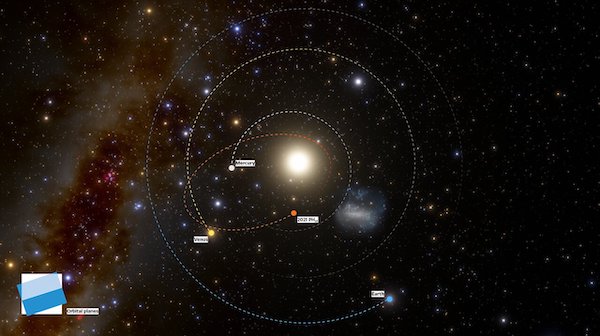
Image via CTIO / NOIRLab / NSF / AURA / J da Silva
“Understanding the population of asteroids interior to Earth’s orbit is important to complete the census of asteroids near Earth, including some of the most likely Earth impactors that may approach Earth during daylight and that cannot be easily discovered in most surveys that are observing at night, away from the Sun,” explained Scott S. Sheppard from the Carnegie Institution of Science.
2021 PH27 was first discovered by Sheppard in images captured by Brown University’s Ian Dell’Antonio and Shenming Fu. As for the asteroid’s origins, the mostly likely theory is that “2021 PH27 was dislodged from the Main Asteroid Belt between Jupiter and Mars and the gravity of the inner planets shaped its orbit into its current configuration,” he said.
There’s also a possibility the space rock could be an extinct comet from the outer Solar System that came too close to one of the planets, resulting in its orbit being brought into proximity with the inner Solar System.
While more observation still has to be done on 2021 PH27, astronomers suspect that the asteroid could be destroyed in a collision with Mercury, Venus, or the Sun, though this isn’t expected to happen for millions of years.
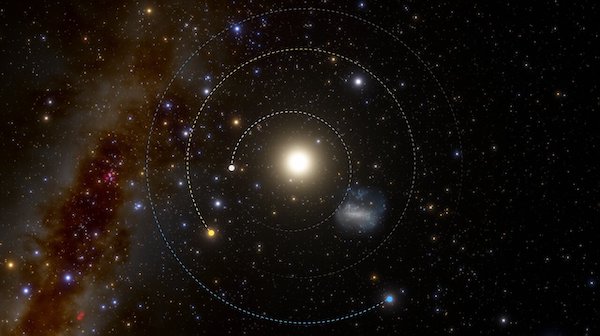
Image via CTIO / NOIRLab / NSF / AURA / J da Silva
[via Forbes, images via CTIO / NOIRLab / NSF / AURA / J da Silva]
Also check out these recent news


