
Police Raid In Brazil Uncovers A 100-Million-Year-Old Flying Reptile Fossil
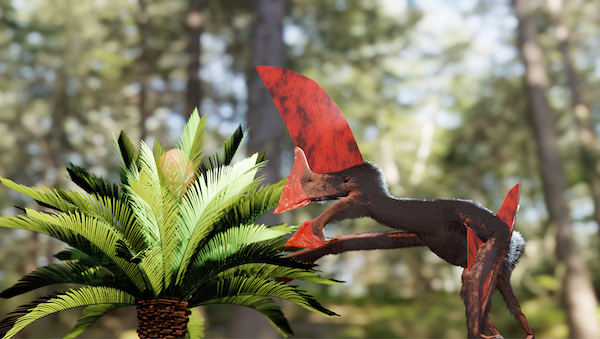
Tupandactylus navigans (artist’s rendering). Image via Victor Beccari (CC BY)
A police raid in Brazil eight years ago uncovered a fossil just as it was about to be shipped out of the country. Turns out, it wasn’t an ordinary discovery. Rather, it was one of the best preservations of a pterosaur ever seen.
The flying reptile is said to have lived over 100 million years ago, and now, paleontologists have managed to reconstruct the specimen. Scientifically named Tupandactylus navigans, the reptile was a type of pterosaur from the early Cretaceous period, which marked the beginning of the end of the dinosaur age.
A team of Brazilian researchers recently published a study on the exceptionally well-preserved fossil, which had been sawed into six pieces by the smugglers, but was able to be put back together.
“We think this fossil is at least 95% complete, which for paleontologists is already a lot, but for a pterosaur is even crazier. Not only the bones but the soft tissue—the crest and the beak,” Victor Beccari, lead author of the paper, told Gizmodo.
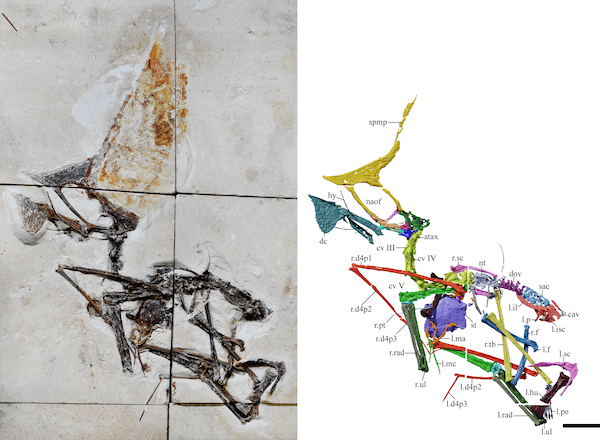
Image via Beccari et al (CC BY 4.0)
Upon receiving the broken fossil, the researchers scanned each piece through a medical-grade CT scanner, imaging every layer of the fossil embedded in the rock. This allowed them to then recreate a 3D model of the reptile’s entire body shape and size.
Due to how large the pterosaur’s head crest was, it’s posited that it was unable to fly long distances. It most likely had a terrestrial foraging lifestyle, and following its death, fossilized in the limestone beds of northeastern Brazil.
The region’s stretch of stone, known as the Crato Formation, is now widely known for its preservation conditions. Other fossils have also been found in the area in the past.
Not everything about the pterosaur is know just yet. Going forward, the research team will be working with the 3D models to better understand how the pterosaur traversed its environment, and more about its ecological niche.
With a fossil this rare, it’s only fortunate it didn’t get shipped out of the country before researchers could get a look at it.
[via Gizmodo, images via Beccari et al (CC BY 4.0)]
Also check out these recent news


