
Another Solar Flare Is Headed Towards Earth, May Disrupt Communication Networks
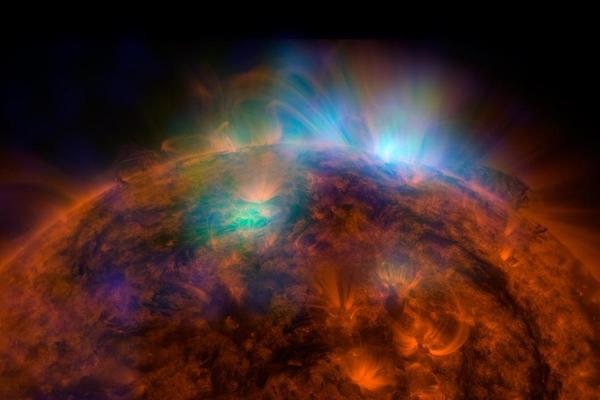
Image via NASA / JPL-Caltech / GSFC
Knowing that the Sun exploded a little on Tuesday isn’t very assuring as it is, but now it’s been reported that its aftereffects look like they’re headed straight towards us on Earth.
This sun spot is located on the Northeast side of the Sun, and it’s called AR2859. On Tuesday, this erupted in a flare, which Chron reports is part of a days-long event.
The eruption could send a mix of plasma and magnetic field, which is released when pressure builds up around a sun spot such as AR2859, in our direction. This is called a coronal mass ejection (CME).
If it’s any reassurance at all, this one is only expected to remain at the lowest severity of a G1 geomagnetic storm. Scientists in the UK have described it as “relatively slow” and “could give a period of Moderate to Strong interplanetary magnetic field” upon its arrival.
all are SUVI images here we see the complete sun. 3/3 😀🙃😀 @_SpaceWeather_ @erikapal pic.twitter.com/2geTI12QTW
— Industrial Engineer Irene Quiroz (@nenecallas) August 24, 2021
A G1 category storm is reported to create disruptions in power grids and satellites, therefore affecting GPS, mobile phone, and TV signals. The National Oceanic and Atmospheric Administration also warns that harmful geomagnetic induced currents may be created in power grids and pipelines.
It’s not all that bad, though: CME are also behind auroras, a beautiful natural phenomenon that will perhaps help the other inconveniences feel less painful.
The UK scientists express difficulty in confirming if Tuesday’s flare will indeed hit the Earth—it’s still too early. However, there was another similar flare earlier in the week, and that looks to be reaching us on August 27.
Geomagnetic storms are actually quite common, according to Chron, with around 150 occurrences each year. Thankfully, the disruptions will be only minor.
[via Chron, image via NASA / JPL-Caltech / GSFC]
Also check out these recent news


