
Interstellar Comets Are Pretty Common Solar System Tourists, New Study Finds
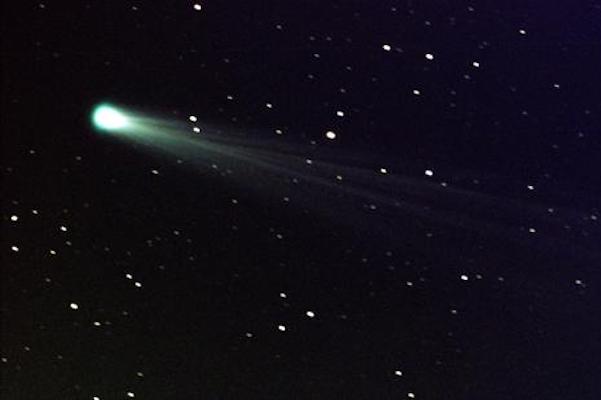
Image via NASA
In late 2019, a comet by the name of Borisov visited our solar system and rapidly flew past Earth. A new study investigating the data from this incident suggests that such “tourists” from other far-flung star systems visiting ours might be more prevalent than we thought.
Amir Siraj, graduate student at Harvard and lead author of the study published in the Monthly Notices of the Royal Astronomical Society, shared with Space.com that it was possible to calculate the probability of foreign comets entering this solar system based simply on Borisov’s appearance.
“Based on the distance that Borisov was detected at, we estimated the implied local abundance of interstellar comets,” Siraj explained, comparing it to the prediction of “the abundance of ‘Oumuamua-like objects [being] calibrated by the detection of ‘Oumuamua.”
‘Oumuamua was the first interstellar body that was detected inside our solar system, and was spotted in Hawaii in October 2017.
Siraj goes on to elaborate that even one object can be used for analysis due to the Poisson method, which calculates the probability of an event reoccurring within a fixed interval of time and space.
In the study, the team concluded that in our solar system, “transitory interstellar comets should outnumber Oort Cloud objects.” It was discovered by Dutch astronomer Jan Oort in the 1950s that the Oort Cloud—a far outer solar system—exists, its spherical shape playing host to small space “things” from within our own solar system: asteroids and comets, in particular.
In other words, there are more comets from outside our solar system than comets from within it.
However, these aren’t as easy to spot as they might seem. Comets are small and travel extremely fast. It’s difficult to capture them, let alone study them in as much detail as the scientists would like. Plus, telescopes have just only started to become powerful enough to even spot them in the first place.
This leaves much to be discovered. With developments in telescopic capabilities and constantly evolving technology, we’ll hopefully be able to learn more about these tourists as they come and go.
For now, as described by the astronomers themselves, “there is still considerable uncertainty regarding the size distribution of the interstellar objects.”
[via Space.com, image via NASA]
Also check out these recent news


