
13,000-Year-Old Native American Campsite Under Farm Details Hunters’ Way Of Life
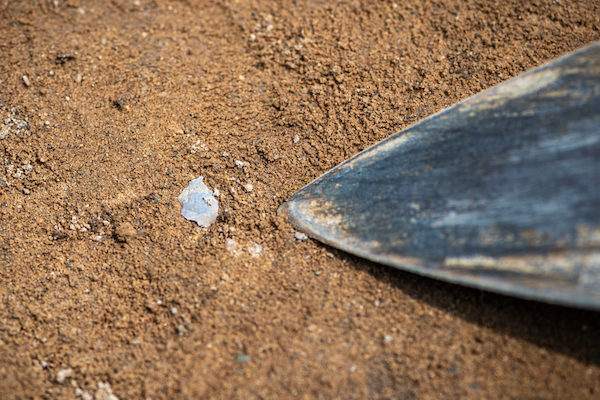
Image via Michigan Photography
A campsite belonging to the Clovis people, who were some of America’s earliest populations, has been uncovered hidden underneath a farm in Michigan.
This same spot used to be covered entirely by peaks of ice dating 13,000 years ago. These weather conditions made it unfavorable to live in, and archaeologists believe that it may have instead been an area for a hunting trip once in a while.
Perhaps, they theorized, the camp would’ve served as a base for a small sub-unit of people who would split off from the main group “seasonally” in order to reach more hazardous areas, which happened to house their favorite prey.
Thomas Talbot, an independent researcher, had been exploring the farmer’s fields after their plowing each spring for years. During this time, he recovered nine pieces of Clovis points. He consulted with Henry Wright, an archaeologist from the University of Michigan, who confirmed that these belonged to the Clovis.
The Clovis people were a Paleoindian culture who populated in the Americas somewhere between 13,000 and 12,500 years in the past. They’re mostly known by their unique spearpoints, like the ones discovered in Michigan.
Due to their rapidly spreading culture throughout the continent, a majority of Native Americans today can still trace their roots back to these very early inhabitants of the land.
In 2020, researchers from the University of Michigan began to dig at the Belson Site, newly named after the farmers who own the land. The news release states that upwards of 20 tools and “hundreds” of material fragments were discovered.
The campsite yielded findings in accordance with the distinct style of spearpoints that the Clovis people were named after. When digging, they found more remnants of tools as well as materials, suggesting that the inhabitants were creating more tools at the site.
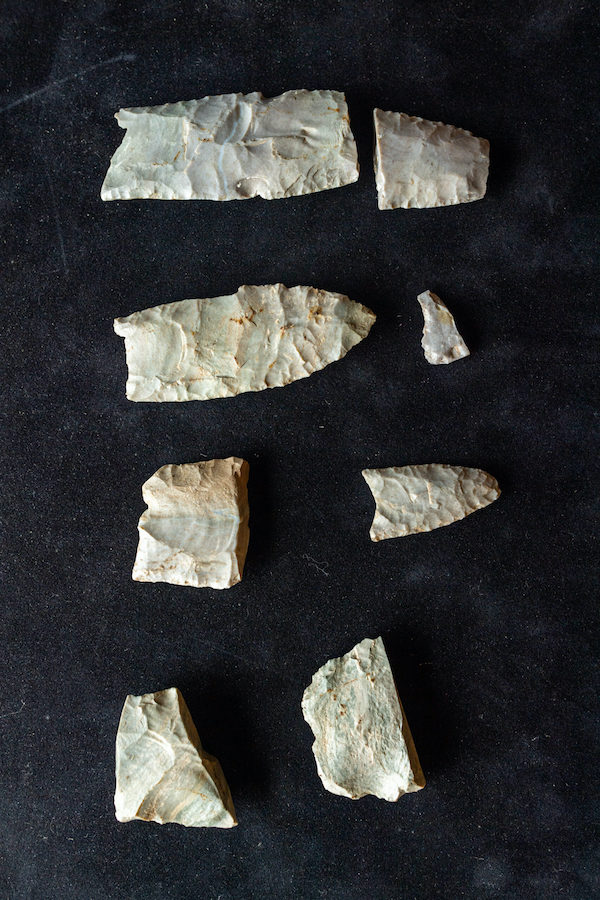
Image via Daryl Marshke / Michigan Photography
However, it is also noted that the points are similar to another set, the Gainey points. After studying the two types, it was concluded that both of these have a flute that runs through the center of the spearpoint, but there are some differences in technology.
The Belson ones “exhibit the large flaking characteristic of Clovis technology” while the Gainey points are “shaped by many strikes,” causing the material to fall off in small pieces.
The samples will undergo protein residue analyses to see if scientists will be able to tell what animals or plants they might have been used on. This would enable them to learn more about Clovis hunting habits and preferences.
Brendan Nash, a doctoral student at the University, states that the findings help to position Michigan’s sites as crucial in their own right to the history of America’s peopling process.
“Michigan culture history has always been thought to be piecemeal of other place’s culture histories that happen to be coming into and out of Michigan periodically,” he explains. These findings prove that the Great Lakes has had a presence that dates back to as early as some other sites, and that its history is equally important.
“We can also say, ‘Maybe it has its own story that’s not just the butt end of the story of every other region. There might be something really unique about its peopling process,'” he adds hopefully.
[via The University of Michigan, images via Daryl Marshke and Michigan Photography]
Also check out these recent news


