
North America Might Face Months Of Internet Blackout If There’s A Solar Storm
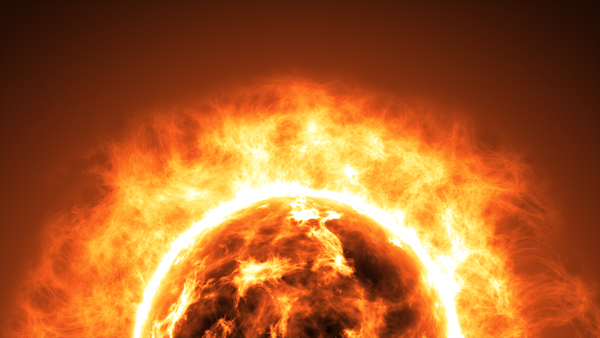
Image via ID 88810048 © Andrey Maslov | Dreamstime.com
Last week, a “solar tsunami” occurred on the surface of the Sun, which caused a huge mass of charged solar particles to stream towards Earth that could reach early next week, according to reports by SpaceWeather.com.
Crazier still, there’s a chance the solar particles could mix with leftover particles from another solar flare last weekend, and may produce a G1-class geomagnetic storm. While it’s likely most of Earth won’t be affected, what’s more worrying is the 1.6% to 12% chance a huge solar superstorm could occur in the future.
This news doesn’t bode well for Earth, especially as the Sun is expected to reach its “solar maximum” in 2024. The Sun has a cycle lasting nine to 14 years, in which at its peak, it produces more electrons and protons than usual, which end up being solar flares and coronal mass ejections (CMEs)—large eruptions caused by magnetic storms that create clouds of plasma that float towards Earth.
New research suggests North America is one of the most vulnerable regions should a superstorm take place. It could even result in an internet outage stretching months. And with internet outages costing the US economy nearly US$7.2 billion a day, we seem hardly prepared for this new type of natural disaster, as per Forbes.
Most of the time, solar flares don’t affect our planet. The Earth’s magnetosphere speeds up the charged particles, directing down the field lines of the North and South poles—which is the phenomenon behind the aurora lights. However, if it does, we are underprepared.
“The networking community has largely overlooked this risk during the design of the network topology and geo-distributed systems such as DNS and data centers,” the paper said, which could mean the internet’s in no way prepared for an eventual solar storm.
This problem is exacerbated by undersea cables, which is where most of the internet connection lies. Fiber-optic cables buried below cities won’t be affected as much, as they’re shorter and grounded. But subsea links between continents are much more vulnerable to an outage.
Additionally, we’ve never managed to test the internet against a solar superstorm. The last solar flare events were recorded in 1859 and 1921, long before Wi-Fi was a thing. We do know that it did disrupt the telegram network, though it’s a lot more analog than the internet.
According to Forbes, high latitudes will face greater risks, such as Europe and North America. Europe tends to use shorter cables, while North America relies on longer cables to go the distance between cities. This could mean it’s more susceptible to internet outages.
Not only could the Wi-Fi be down for months, but solar storms could also affect satellites in orbit. With Elon Musk planning to send thousands of satellites into orbit as part of the Starlink constellation, it could be among the worst-hit objects.
“GPS and communication satellites which are directly exposed to solar storms will suffer from lost connectivity during the event, potential damage to electronic components, and in the worst case, orbital decay and re-entry to Earth (particularly in low Earth orbit satellites such as Starlink.”
With the Sun’s “solar maximum” just three years away, should we be looking for new solutions just in case a solar tsunami affects Earth too? Instead of working from home, we could end up just not working at all if the internet goes out for months.
[via Forbes, cover image via ID 88810048 © Andrey Maslov | Dreamstime.com]
Also check out these recent news


