
The Northern Lights Don’t Just Look Phenomenal, They Also Sound Peculiar
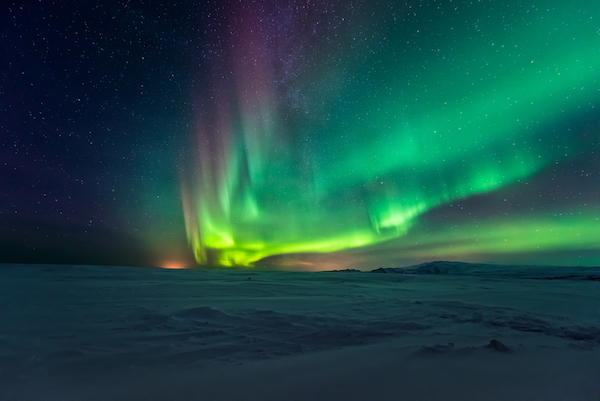
Image via photo ID 50373377 © Surangaw | Dreamstime.com
The Northern Lights, or aurora borealis, are usually thought of as a highly photogenic phenomenon lighting up the skies of the Arctic Circle. But as a Finnish study shows, they offer quite an auditory experience too.
Although visitors and locals have reported hearing these noises, there wasn’t any evidence to back it up until the study by acoustics researcher Unto K. Laine confirmed there were indeed noises and “claps” associated with the lights.
This study has stretched on for years. Back in 2011, Laine’s first success was recorded when he found the origin of the sounds using three microphones and magnetic field measurements.
To further his investigations, he used calculations based on a mathematical model to test his hypothesis: sounds are being generated when a temperature inversion layer is “discharged” at a height of around 75 meters (246 feet). This is due to the magnetic storm created by the Northern Lights.
“I tested it with two hours of material I recorded in Fiskars in 2013,” Laine explains in a news release by Aalto University, where he’s now a professor.
“The model fitted the hypothesis beautifully and at the same time gave the height of the inversion layer more precisely at 78–80 meters [256–262 feet].”
These temperature inversion layers he mentions are formed when warm air rises from the ground and is surrounded by layers of cooler air. Here, the warm air absorbs positive charges from the atmosphere and negative charges from the ground.
Solar particles that cause the Northern Lights hit these layers as the phenomenon occurs. This prompts the noise that Laine has been investigating for years, and it’s said to be reminiscent of radio static.
Despite the hypothesis being proven, it’s largely noted that Laine’s theory is just one possibility. The research will continue to debunk the mystery of one of the world’s most beautiful natural occurrences.
[via Mental Floss, image via photo ID 50373377 © Surangaw | Dreamstime.com]
Also check out these recent news


