
Ancient Pottery Shows Chinese Townsfolk Drank Beer At Funerals 9,000 Years Ago
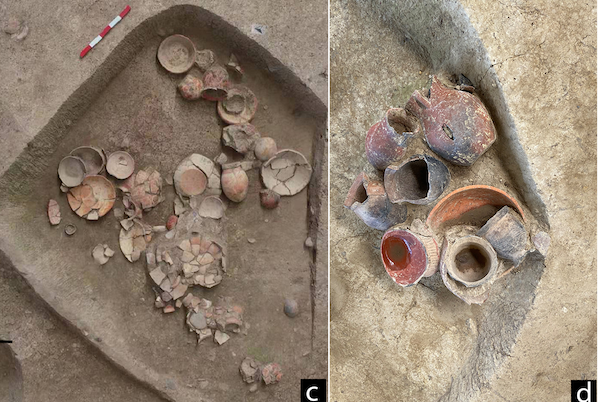
Image via Wang et al. (CC BY 4.0)
A new study reveals that beer was made and drunk as part of a funerary ritual in Qiaotou, China, up to 9,000 years ago.
To come to this discovery, pottery vessels of varying sizes and make that were found in a burial site underwent analysis, after being unearthed in a manmade ditch measuring around six feet in depth. They were discovered alongside two human skeletons and a few pottery pits.
These small pots came in a similar size to today’s cups, easily held in one hand, and were decorated with abstract designs in white. The study published in PLOS ONE concludes that these artifacts are among the “earliest known painted pottery in the world.”
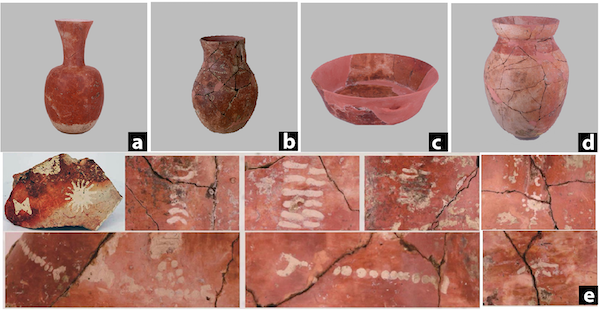
Image via Leping Jiang
Researchers found this burial site situated in Qiaotou, a town in southern Zhejiang province, China. 9,000 years ago, the area was relatively new to domesticating rice, and harvesting it was still a labor-intensive process. Therefore, the team concluded that the beer that was drunk here must’ve been a “ritually significant beverage.”
At Qiaotou, large numbers of the vessels and bowls were discovered in burial pits, suggesting that drinking beer was an integral part of a funeral. This would also explain why it was so significant to the people in this society.
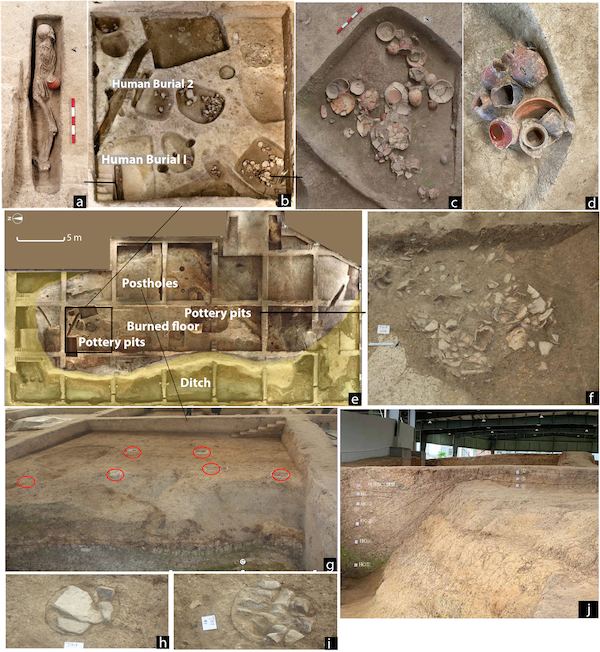
Image via Wang et al. (CC BY 4.0)
In the news release, it’s stated that the team speculate that drinks like these were “integral to forging social relationships and cooperation.” This in turn contributed to the development of “complex rice farming societies” that developed 4,000 years down the line.
To reach the conclusion that it was indeed beer that was enjoyed at the time, the team analyzed the microfossil residues left behind on the material. From the pots’ interiors, starch, fungi, and phytolith (fossilized plant residue) were extracted and examined.
This was compared to samples of soil from the area surrounding the excavation site. Showing different compositions to the soil, the pot’s residues contained starch granules, phytoliths, mold, and yeast. This is more consistent with the fermentation process of beer instead.
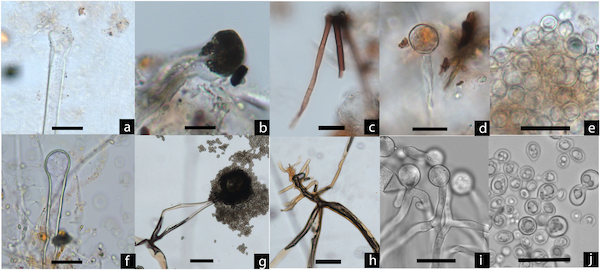
Image via Wang et al. (CC BY 4.0)
Mold found in the pots was attributed to the beermaking process. Findings showed that the mold found at Qiaotou was similar to mold in koji, which is used to make sake and other East Asian fermented rice-based beverages.
“We don’t know how people made the mold 9,000 years ago, as fermentation can happen naturally,” explains study co-author Jiajing Wang. “If people had some leftover rice and the grains became moldy, they may have noticed that the grains became sweeter and alcoholic with age.”
Of course, this isn’t quite the same as today’s IPA. The beer of 9,000 years ago was shown to have been made from rice, a grain called Job’s tears, and some other tubers. According to Wang, it would’ve been “a slightly fermented and sweet beverage, which was probably cloudy in color.”
[via ScienceDaily for Dartmouth College, images via Wang et al. (CC BY 4.0)]
Also check out these recent news


