
‘Acrobats Of The Skunk World’ Perform Handstands To Intimidate Potential Threats
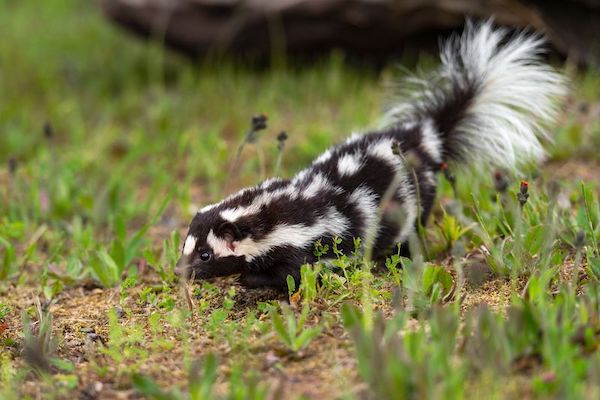
Image via ID 210913149 © Holly Kuchera | Dreamstime.com
Spotted skunks are deemed the “acrobats of the skunk world,” and for good reason.
Kicking up their back legs, these little creatures flip in and out of a handstand easily, and it’s a move used to ward off predators even if they’re 10 times bigger. Coupled with a puffed-up tail and the ability to walk on their hands, they make themselves look much bigger than they actually are.
Then, they drop back down onto all fours before they hit the disoriented victim with their nasty-smelling spray—as if to confirm, “yes, you just saw a skunk.”
Appearing larger might come in handy for the petite species, which tends to hover at around two pounds. This is barely anything compared to their 10-pound-and-above cousins, the striped skunks.
It was previously thought that there were around four species of this unique skunk. However, the number is now being challenged: seven is the new figure, according to the study published in the journal Molecular Phylogenetics and Evolution.
“Everyone thinks we know everything about mammalian carnivore systematics, so being able to redraw the skunk family tree is very exciting,” says Adam Ferguson, one of the paper’s authors and the collections manager of mammals at Chicago’s Field Museum, in the news release.
The genus had never been fully analyzed using genetic data, so there was always some mystery as to what the skunk family actually looks like. Additionally, the thought of being sprayed by a skunk is enough to deter anyone, even in the name of science.
So the team came up with a better way of accessing skunks, and that was through sourcing roadkill. “People recognize spotted skunks as something special, because you don’t see them every day,” explains Ferguson.
Unlike their relatives, spotted skunks aren’t commonly found in urban areas, and remain in dense, remote environments instead. This makes them even more elusive.
These findings, while fascinating, also offer a more protective function for these gymnastic creatures. Results revealed that the splitting of species was due to climate change during the Ice Age. These different lineages may hold hints for species conservation in the future.
[via CNN, image via ID 210913149 © Holly Kuchera | Dreamstime.com]
Also check out these recent news


