
Giant Half-Billion-Year-Old Predator Species Discovered In Canadian Rockies
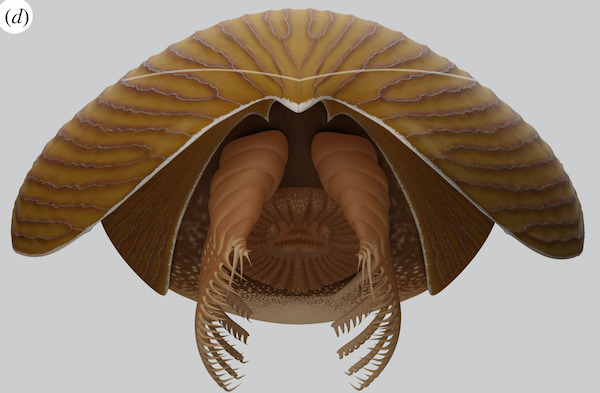
Image via Lars Fields, Royal Ontario Museum
More than 500 million years ago, the Cambrian Explosion took place, with the Earth’s oceans full of prehistoric creatures that would eventually evolve into the marine life we know today.
Recently, one of the half-billion-year-old creatures was discovered in the Canadian mountains, and it’s among the largest-ever animals scientists have collected from that period.
Named the Titanokorys Gainesi, the creature had multifaceted eyes, a ring-shaped mouth, claws to snatch prey, and flaps to help it swim. Its head was also covered in a huge carapace, which is similar to a hard shell on a tortoise.
“The first specimens were found in 2014, but it wasn’t until 2018 that we discovered a particularly pristine carapace [and] we recognized the significance of this find,” Joe Moysiuk, co-author of the latest study, told Gizmodo.
“I recall hearing a gasp followed by a lot of yelling and everyone crowding around. We’ve found a lot of cool things, but this one really left an impression!”
The fossil was found hidden in the Burgess Shale, a stretch of rock in Canada that has provided well-preserved remains of creatures from the Cambrian era previously. And one thing that really stood out to the scientists was the size of the T Gainesi.
According to Gizmodo, most animals during the period were smaller than a pinkie finger, but this fossil contained a creature nearly a foot and a half long—enormous for creatures of that period.
“The sheer size of this animal is absolutely mind-boggling, this is one of the biggest animals from the Cambrian period ever found,” said the study’s lead author Jean-Bernard Caron.
It’s likely the creature glided through the water like a giant balloon, floating above the seafloor waiting to strike prey.
This amazing discovery has helped expand scientists’ knowledge of predators during the Cambrian period. And who knows, they might find more 500-million-year-old fossils soon.
For more on the research, check out the study here.
[via Gizmodo, cover image via Lars Fields, Royal Ontario Museum]
Also check out these recent news


