
See An Unusual ‘Dog Bone’ Asteroid In Most Precise Model To Date
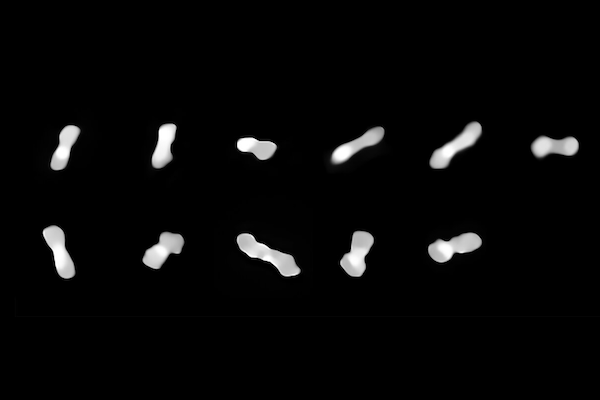
Image via ESO/Vernazza, Marchis et al./MISTRAL algorithm (ONERA/CNRS)
Astronomers have managed to capture the most detailed images to date of the asteroid Kleopatra using the European Southern Observatory’s Very Large Telescope (ESO’s VLT).
This asteroid, endearingly termed the “dog-bone asteroid” for the last two decades, orbits the Sun from its location between Mars and Jupiter. It gets its name from its structure: two lobes which are connected by a thinner “neck.” Apart from a bone, it also resembles a dumbbell.
It’s described as a “weird outlier” by Franck Marchis, an astronomer who led the study on the asteroid published in the journal Astronomy & Astrophysics. However, it’s exactly these outliers that ensure scientific progress.
In the study, Marchis and his team created a 3D model of the structure using images captured of Kleopatra between 2017 and 2019 by the VLT’s Spectro-Polarimetric High-contrast Exoplanet REsearch (SPHERE) instrument.
This 3D model shows that the dog bone shape stretches around 270 kilometers (168 miles) long, and that one of the lobes is larger than the other. Since the model was created from images taken at different points of its rotation, it’s the most accurate one to date.
A second study, published alongside the first, was led by Miroslav Brož to investigate the two moons that orbit this strange space structure. Named after Kleopatra’s children, the moons—AlexHelios and CleoSelene—were found to have different orbits than previous research showed.
Consequently, the new orbits enabled the team to find Kleopatra’s real mass. Before, this had been based on estimations of how its gravity affected the moons’ orbits. These new findings showed the asteroid’s mass to be around 35% lower than the previous values.
2/ Kleopatra orbits the Sun in the Asteroid Belt between Mars and Jupiter. Astronomers have called it a “dog-bone asteroid” ever since radar observations around 20 years ago revealed it has two lobes connected by a thick “neck”.
— ESO (@ESO) September 9, 2021
Credit: @ESO /spaceengine.org pic.twitter.com/lHFfXbb2Js
Combining the values of volume and mass, the researchers were also then able to calculate the “true” density of the asteroid, which turned out to be less than half of the previous estimated value.
The strange structure was therefore deemed to have a porous structure, which indicates its formation took place when material reaccumulated after a huge impact.
“This system certainly deserves particular attention in the future,” the team concludes, suggesting that more Extremely Large Telescopes and “possibly a dedicated space mission” will be required to uncover its history.
[via SciTechDaily, image via ESO/Vernazza, Marchis et al./MISTRAL algorithm (ONERA/CNRS)]
Also check out these recent news


