
What Happens To The Sun When It Dies? Scientists Have Modeled It To Find Out
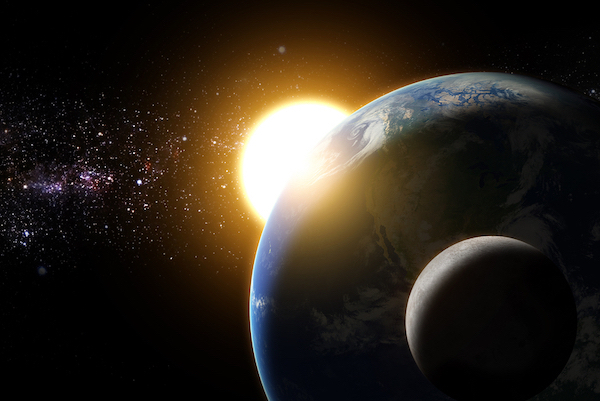
Image via ID 54817370 © Blackzheep | Dreamstime.com
Everything will meet its end someday, including the Sun. This has always been known, and scientists have agreed that it will die sometime ten billion years into the future. But what happens next?
That’s the question this international team of astronomers set out to answer in their study published in Nature Astronomy.
Currently, our Sun is estimated to be around 4.6 billion years old, according to ScienceAlert. Before it reaches its end of life in around 10 billion more years, scientists predict that there will be other rather terrifying occurrences that precede this.
These include the star turning into a “red giant” in five billion years. While its core will shrink, the outer layers are due to expand to the orbit of Mars, which means that Earth will be swallowed in the process.
If it’s any reassurance, humanity won’t be around on the planet by that time—we’re due to leave in about a billion years’ time, thanks to the rising temperature of the Sun.
So far, all this has been previously agreed upon. However, once the red giant is formed, things get a little murkier. Previously, it was believed that it’d turn into a planetary nebula, which is a luminous cluster of gas and dust. But for this to form, the initial star needs a mass twice the size of the Sun, which caused scientists to doubt if this was really going to be the Sun’s fate.
“When a star dies it ejects a mass of gas and dust—known as its envelope—into space. The envelope can be as much as half the star’s mass,” explains astrophysicist Albert Zijlstra from the University of Manchester, one of the study’s authors.
“This reveals the star’s core, which by this point in the star’s life is running out of fuel, eventually turning off and before finally dying.”
To find out if the Sun would turn into the nebula predicted, the team created a data model to predict the brightness of the ejected envelope for stars with varying masses and ages. This is so they could try to capture a pattern in their lifecycles.
These newer 2018 models showed that after the envelope was flung into space, the stars heat up around three times faster than was discovered in older models. This speed ensures that a star with lower mass, like the Sun, can still form a bright planetary nebula, and it’s easier for them to do so too.
The lowest mass star studied is roughly the same mass as the Sun, and it still produced a visible nebula, although it was faint. However, it’s lucky that one came about in the first place, as the team reports that stars even a few percent smaller don’t produce these.
But since humanity won’t be around to see it all unfold, and we’ll probably be on Mars, we might unfortunately never know how accurate this prediction really turns out to be.
[via ScienceAlert, image via ID 54817370 © Blackzheep | Dreamstime.com]
Also check out these recent news


