
Young Neanderthal Man With Tumor On Face Has Been Stunningly Reconstructed
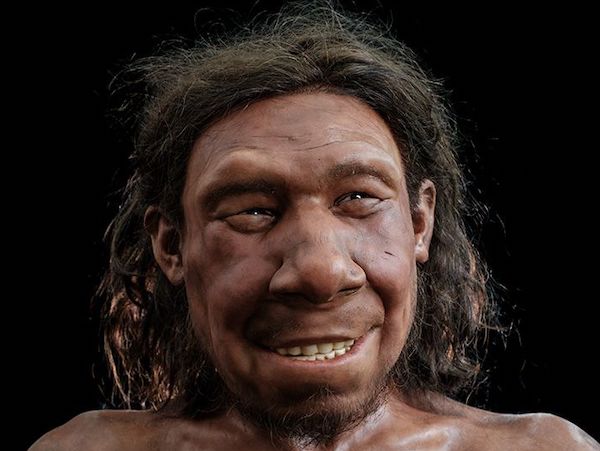
Image via National Museum of Antiquities Netherlands
By most accounts, ‘Krijin’ the Neanderthal man lived a tough life, though that was the norm during his time. Where he resided, Doggerland—a sweeping area of land between the United Kingdom and continental Europe—was a cold place. He also had a lumpy tumor on his face, a feature that remains “very distinctive” on a chunk of his skull 50,000 to 70,000 years later.
A part of the skull of Krijin, as he is now called, was unearthed among sediments from the bottom of the North Sea by an amateur paleontologist in 2001. Now, reconstruction artists have recreated his face in a lifelike bust—complete with a contagious smile—from that piece of bone.
Adrue Kennis, a paleo-anthropological artist from Kennis & Kennis Reconstructions, said Krijin is able to greet successors thousands of years down the line because the hunk of frontal bone is “a very distinctive piece.” The lump above his right eyebrow tells a story that a tumor used to be there. And for a complete picture of skin tone, eye, and hair color, artists looked to other Neanderthal skulls.
Today, the humanlike reconstruction of the “first Neanderthal in the Netherlands” is hanging out at the Netherlands’ National Museum of Antiquities (RMO) as part of a new exhibit dedicated to his homeland of Doggerland.
There’s a little more that scientists know about the young early man with the tumor. From his skull alone, they were able to distinguish variants of carbon and nitrogen which suggested Krijin was “highly carnivorous,” Live Science reported. The study was published in the Journal of Human Evolution in 2009. Seafood didn’t seem to be part of his diet, but with the horde of mammoths, horses, reindeer, lions, and woolly rhinoceroses that lived in the region, he probably didn’t have much trouble finding food.
The bulge on his face is believed to be an intradiploic epidermoid cyst, an uncommon, slow-growing lesion that’s typically benign. Those who have it might experience pain and swelling, headaches, visual issues, dizziness, convulsions, or seizures, but they also may not get these symptoms at all. For Krijin, since his tumor is considered small, it’s possible he didn’t suffer too much from it.
The skull fragment was found among other middle-Paleolithic artifacts, like pointed stones and small hand axes, originating from land now submerged in the North Sea. Krijin is also credited to be the first Neanderthal to be discovered with this type of tumor.
To meet him up close, archaeology buffs might want to check out the new Doggerland: Lost World in the North Sea at the National Museum of Antiquities, where Krijin’s bust will be until October 31.
[via Live Science, video and image via National Museum of Antiquities Netherlands]
Also check out these recent news


