
Kids Made This 200,000-Year-Old Art Near Tibetan Hot Springs, Scientists Believe
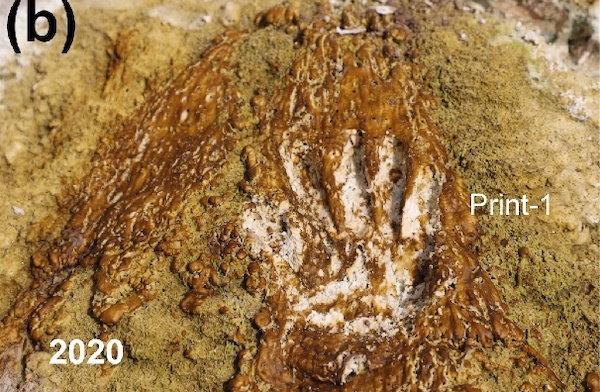
Image via D.D. Zhang et al / ScienceDirect (CC BY-NC-ND 4.0)
A team of researchers have discovered handprints and footprints at Quesang, located in the Tibetan Plateau. The fossilized impressions were thought to be between 169,000 to 226,000 years old, and could potentially be the earliest known example of such artwork.
Ancient art of a similar nature is categorized as parietal art, which typically has been uncovered on cave walls, though it can also appear on the ground, like in this case. Other than being the oldest-known discovery of such impressions, researchers have also posited the site is the earliest confirmation that hominins made it so high up on the Tibetan Plateau.
In a study published by the team, Thomas Urban, a research scientist at Cornell University explained the difference between regular hand and foot prints, as compared to those thought of as art.
“How footprints are made during normal activity such a walking, running, jumping is well understood, including things like slippage. These prints, however, are more carefully made and have a specific arrangement—think more along the lines like how a child presses their handprint into fresh cement,” he said.
The five hand and foot impressions were made in the mud near the Quesang Hot Spring. Over the last 200,000 years, the mud lithified into travertine rock. These prints weren’t discovered till 2018, though the study’s lead author David Zhang had discovered a different set of impressions near a bathhouse back in 1988.
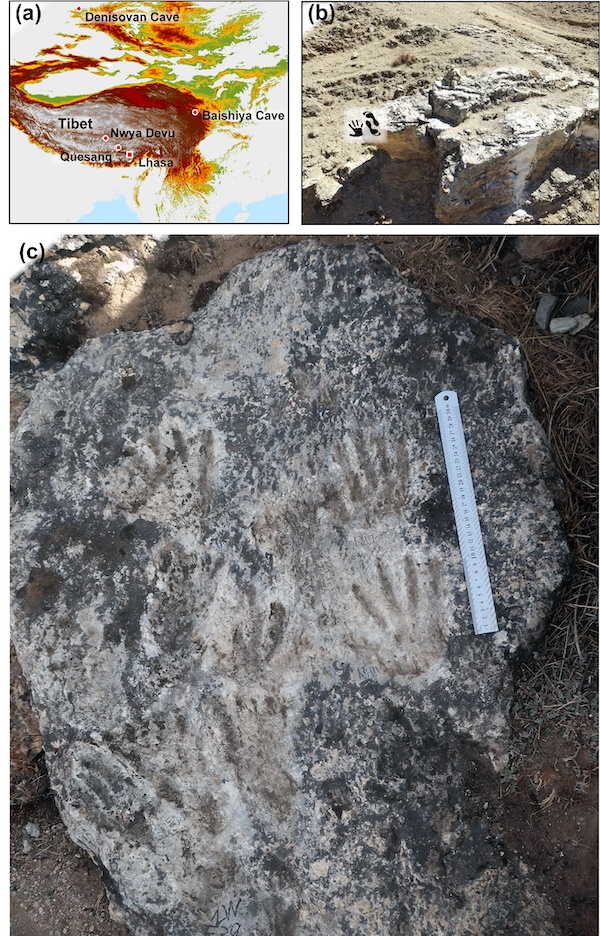
Image via D.D. Zhang et al / ScienceDirect (CC BY-NC-ND 4.0)
Looking at the size of the prints, the team said the artists were probably a seven-year-old and 12-year-old. However, if they were left by species other than Homo Sapiens, the age estimates could be skewed.
Additionally, not everyone might agree that these impressions constitute as art, though most scientists agree they were left behind deliberately.
“It is the composition, which is deliberate, the fact the traces were not made by normal locomotion, and the care taken so that one trace does not overlap the next, all of which shows deliberate care,” Matthew Bennett, a geologist at Bournemouth University, told Gizmodo.
“Symbolic behaviors such as language, religion, and art must have simpler manifestations early in the human story—so if you’re looking for the earliest art, don’t go looking for the Mona Lisa or you’ll likely be disappointed,” summed up co-author Urban.
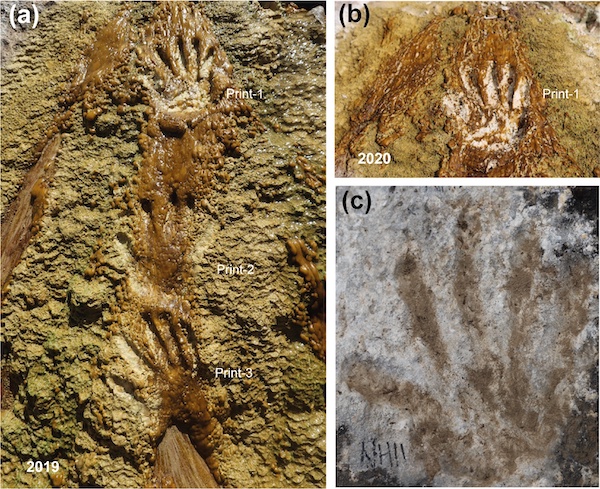
Image via ScienceDirect (CC BY-NC-ND 4.0)
[via Gizmodo, images via D.D. Zhang et al / ScienceDirect (CC BY-NC-ND 4.0)]
Also check out these recent news


