
Australia To Adopt Fleet Of Nuclear-Powered Submarines For Navy
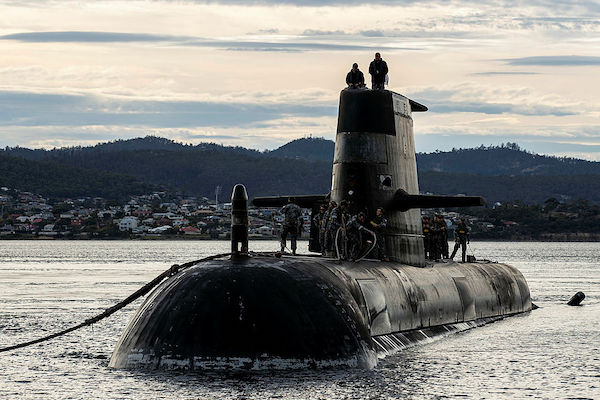
Image via Royal Australian Navy
As part of a new agreement with the United States and United Kingdom, the Australian Navy is set to deploy a new fleet of nuclear-powered submarines.
Initial efforts from this trilateral agreement will include areas such as “cyber capabilities, artificial intelligence, quantum technologies, and additional undersea capabilities,” according to a White House statement.
Prime Minister of Australia, Scott Morrison, said on Wednesday that the agreement, termed AUKUS, has plans in place to build nuclear-powered submarines in Adelaide, Australia in cooperation with the other two countries. The number has not yet been specified.
These nuclear submarines may potentially come with a land-attack strike capability even when the vehicle is underwater. Nuclear-propelled boats are much faster, as well as capable of staying submerged for longer periods of time.
Even the most advanced boat that utilizes fuel cell technology still needs to surface occasionally, including to refuel, according to The Drive.
These advances in technology would enable the ships to patrol the expanses out at sea, especially in the Pacific, for much longer periods of time. They’ll also be able to reach destinations faster for more efficient patrolling, and will undoubtedly come in handy in times of emergency.
Modern submarines are already capable of quite a lot—as well as being able to survive ship and fellow submarine warfare, they’re also used to carry out special operations, long-range strike, and even provide a space to gather intelligence from.
With the implementation of nuclear propulsion to enhance these, the new submarine fleet will be showcasing all this and more in the Indo-Pacific. This is a move that appears to counter China’s growing influence, as noted by Reuters.
The Drive also reports that a study in 2013 by the US’ Center for Strategic and Budgetary Assessments investigated nuclear-powered submarines.
These findings revealed that in comparison to 11 days with conventional diesel-electric submarine, a nuclear-powered submarine operating from Perth could remain in place in the South China Sea for around 77 days.
Currently, Australia is under the Nuclear Non-Proliferation Treaty (NPT), which prohibits non-nuclear weapon states from developing this technology. PM Morrison has also insisted that the new nuclear submarine plan doesn’t violate this and that the country doesn’t intend to build weapons.
No further details on the new nuclear boats, which are expected to replace the existing Collins class Australian submarines, have been revealed yet.
[via The Drive, image via Royal Australian Navy]
Also check out these recent news


