
A Tree Trunk Coffin Was Exceptionally Preserved Underneath A Golf Course Pond
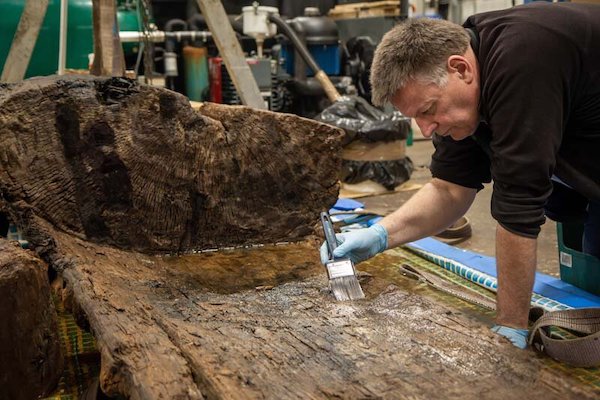
Image via York Archaeology
At the Tetney Golf Club in Lincolnshire, northwest England, in the summer of 2018, works were being carried out in one of the ponds. Then they discovered something sitting at the bottom of it.
A £70,000 (US$96,600) grant from Historic England and lots of excavation later, the rescue mission revealed a coffin, made out of a hollowed tree trunk, dating back almost 4,000 years ago to the Bronze Age.
This coffin measures around three meters (9.8 feet) long and a meter (3.3 feet) wide. The tree trunk had been halved lengthwise then hollowed out before the body was laid inside.
Then, plants—yew and juniper leaves were identified thus far—were used to cushion it, as explained by York Archaeology, the organization in charge of preservation work.
Inside, the archaeologists discovered the remains of a man who was buried neatly alongside an almost-perfectly-preserved axe.
Upon burial, a gravel mound was raised over the coffin, the organization’s blog post states. This suggests that the person who was buried maintained a high status, as was customary for important figures in Bronze Age society.
This was further evidenced by the axe, which appeared to be more of a “symbol of authority” than a weapon. An extremely rare find, as there are only 12 known to date in Britain, made even more unique by the fact that its wooden haft survived alongside the stone head.
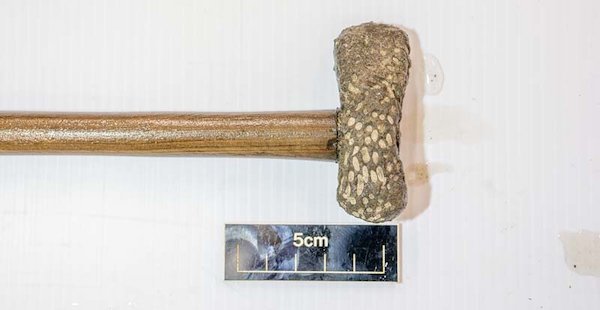
Image via York Archaeology
Due to wood’s tendency to deteriorate rapidly, as soon as it was exposed to oxygen and the natural elements, it was a race against time to ensure it wouldn’t crumble away. Only 64 other tree trunk coffins are known in the country to date due to their fragile form.
While undergoing analysis prior to restoration, it had spent a year in cold storage to ensure that it didn’t fall apart before the researchers were done.
Dr Hugh Wilmott, senior lecturer in European historical archaeology at the University of Sheffield, states in the blog post that it was by pure luck that he, alongside a team of staff and archaeology students, were nearby. They had been working, coincidentally, on a research and training excavation.
“This was a brilliant learning experience for our students to see what can be achieved at short notice. I’m so pleased the University of Sheffield Department of Archaeology was able step up and help,” he says.
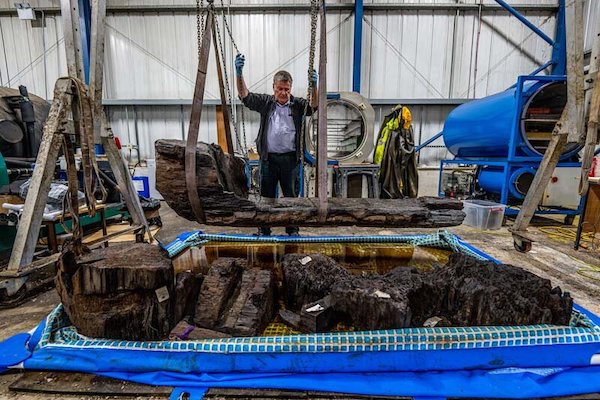
Image via York Archaeology
Once the coffin and axe have been preserved by York Archaeology, they will be moved to The Collection Museum in Lincolnshire, where the discovery was made.
There will also be a “nice photograph” of the axe up on the Clubhouse wall back at the golf club, owner Mark Casswell says. “It’s certainly something to think about while you’re playing your way round the course.”
[via The Guardian, images via York Archaeology]
Also check out these recent news


