
New Energy-Saving Freezing Tech Keeps Food Fresher And Leaves No Ice Crystals

Image via Angel Sinigersky / Unsplash (CC0)
Freezers are great. Not only are they the reason we get to enjoy the wonderful invention that is ice cream, they’re also the reason food can be kept fresher for longer without its quality deteriorating. Their drawback, however, is that they are large consumers of energy.
But now, a new freezing technology promises to keep food at even better quality than a conventional freezer, all while requiring less energy expenditure.
Isochoric freezing, although first developed in 2005 to harness the powers of below-zero to preserve tissues and organs for transplants, is being investigated as an alternative method of food preservation.
This requires the object to be put into liquid inside a closed “chamber.” When the container cools, this liquid protects the submerged object from ice crystals forming on it while preserving its qualities better.
The potentials for this technology were investigated in a study published in the journal Renewable Sustainable Energy Reviews. Researchers from the USDA and UC Berkley found that if the whole world switched to this new method of cryopreservation, energy savings could reach 6.5 billion kilowatt-hours each year.
Alongside this, carbon emissions, associated with generating power, are also reduced: 4.6 billion kilograms (10.1 billion pounds), or the equivalent of eradicating a million cars from the road.
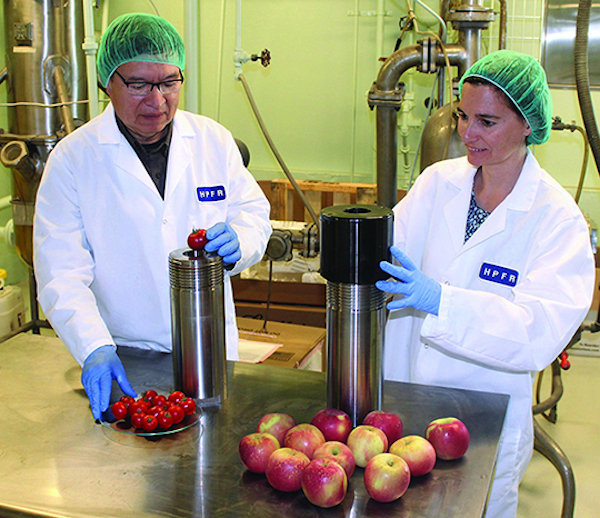
Image via USDA
According to study co-author Cristina Bilbao-Sainz, this can be achieved without needing to drastically alter the current frozen food system, including its equipment.
Though the chambers used in research had been made from steel, it’s possible to make them out of plastic or carbon fiber composites, which are lighter. These could then be placed inside an industrial cold room or even a freezer at home, implementing the technology without needing to invest thousands into brand new equipment.
There’s also another benefit to isochoric freezing: it also kills microbial contaminants. Apart from medical procedures and food storage, this method could be used in countless other industries.
Matthew Powell-Palm, one of the study’s authors, even cites space travel as a possibility.
[via New Atlas, images via Angel Sinigersky / Unsplash (CC0) and USDA]
Also check out these recent news


