
The Giveaway That A ‘Person’ In A Photo Is An AI-Generated Fake
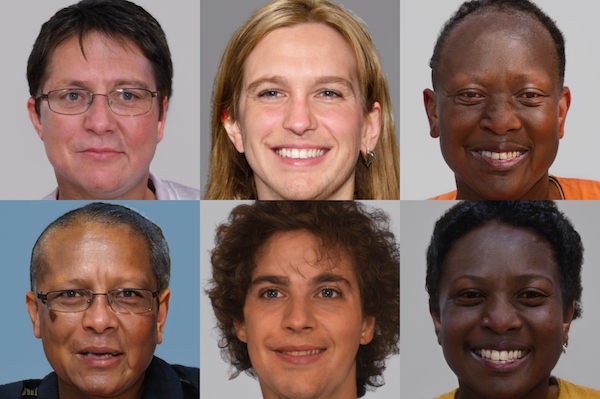
AI-generated faces. Images created via Face Generator
With years of practice up its sleeves, artificial intelligence (AI) is now able to generate faces that look so real, it’s almost indistinguishable from actual people’s photographs.
But the key is in the word “almost.”
There’s one little telltale flaw, and that’s in the window to the soul: eyes. The generative adversarial networks (GANs) that produce these synthetic faces struggle to replicate some facial features that aren’t always the same, or at least similar-looking.
GANs work via the person behind the operation feeding images of real faces into a neural network, then getting it to generate its own faces after it has “learned” what features like eyes and noses look like and where they tend to be located on the face.
Then, these generated images are tested against a different neural network, which is tasked with spotting the fakes. Sort of like a peer review, it’ll enable the first network to “learn” from its mistakes to be able to generate better faces in the future.
But, like the best of us, these aren’t perfect. Things like glasses, earrings, and nose piercings all end up looking a little questionable, to put it nicely.
Apart from these elements, another thing the GANs struggle with is coming up with regularly-shaped pupils. Ours are often circular or elliptical. AI-generated faces end up with wonky-looking ones, sort of like misshaped pancakes.
This was discovered by a team led by Hui Guo at the State University of New York. In a paper stating their findings, the researchers explain that “this phenomenon is caused by the lack of physiological constraints in the GAN models.”
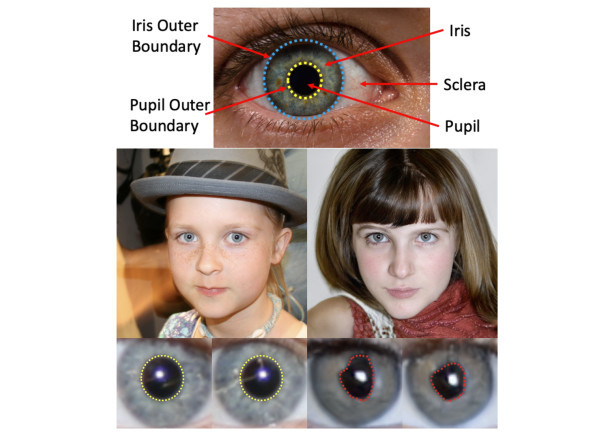
Image via Guo et. al
Who knew it could’ve been that easy?
While it’s good to know that we can spot if someone in an image is actually non-existent, the knowledge that has been shared today will also reach the creators of GAN-generated faces, who will undoubtedly find a workaround. But who’s to say that another small telltale flaw won’t pop up in the future?
And the cycle continues.
[via Boing Boing, images via Face Generator and Guo et. al]
Also check out these recent news


